
Media coverage has centered the fears of a cis politician who was yelled at while ignoring families with young children terrorized by police brandishing weapons at peaceful protesters.
The journalistic verdict on this year’s Trans March in San Francisco has been rendered: The trans community has been found guilty of being too radical, too frightening, too destructive.
The viral story to have emerged from the annual march on Friday June 26 was an indicent of harassment targeting Jewish politician Scott Wiener in Dolores Park before the march proper. The incident made national news, meriting coverage in the paper of record. (I also wrote about it, here.)
Largely subordinate to the coverage of the Wiener incident there was another story to come out of Trans March, of a police action responding to alleged acts of vandalism by a small group within the marchers. When the two stories have been combined, they paint a picture of the march as radical, angry, and even lawless.
For those in attendance, this picture feels unfair and one-sided. It has contributed to a sense that trans people’s lives and safety aren’t equally valued, even in a city historically known for its close connection to the LGBTQ+ community.
“A lot of people don’t realize the largest part of the day is not the march itself. There’s a rally and a resource fair gathering in Dolores Park, which is just really lovely, especially for children,” explained Arne Johnson, who attended Trans March with his 14 year old daughter as part of Rainbow Families Action. This gathering was where Wiener was confronted, but it was also where tens of thousands of trans people and allies gathered in a street fair atmosphere with art and music where Johnson felt safe enough to let his child roam about unsupervised.
That peaceful vibe, which carried on into the march itself, is why it came as such a shock when Johnson and his daughter were part of a group charged by police in combat gear wielding riot-suppressing weaponry.
“When we got down to the end of the march there was some kind of tension in the air,” he said. “We were just getting ready to go get something to eat, and as we turned around, suddenly there were all of these police officers charging down the street, running right at us. Some of them had weapons drawn.”
In Johnson’s mind, and that of his child, the police had been there to protect the marchers. Being treated as enemies, as “a rabble” in Johnson’s words, was outside of their experience.
Johnson described seeing 20 to 30 police officers charging the crowd along with police cars forcing marchers to scatter. What felt the most frightening was that there was no communication, no clear way for march attendees to know where to go or how to remain safe in the face of the police onslaught. That night, Johnson’s daughter had nightmares.
The incident raises questions about the function of police at peaceful rallies, questions that have bubbled below the surface of Pride events for years, as increasing acceptance of LGBTQ+ people slowly morphed what were once protests in remembrance of violent police oppression into celebrations of community that some police officers have sought to participate in as marchers.
For Trans March organizer Niko Storment, who is transmasculine and uses he and they pronouns, San Francisco police failed in their responsibility to the marchers, not just in what they did respond to (alleged vandalism by a small group of marchers) but also in what they failed to respond to.
“The purpose of police at Trans March is traffic control,” Storment explained. “Earlier in the day there was an incident where an aggressive driver did not want to wait at the intersection, and they drove into our crowd, and we did have some injuries. Our community safety did deescalate that situation and minimized a lot of the hurts, however the SFPD did nothing in that situation.”
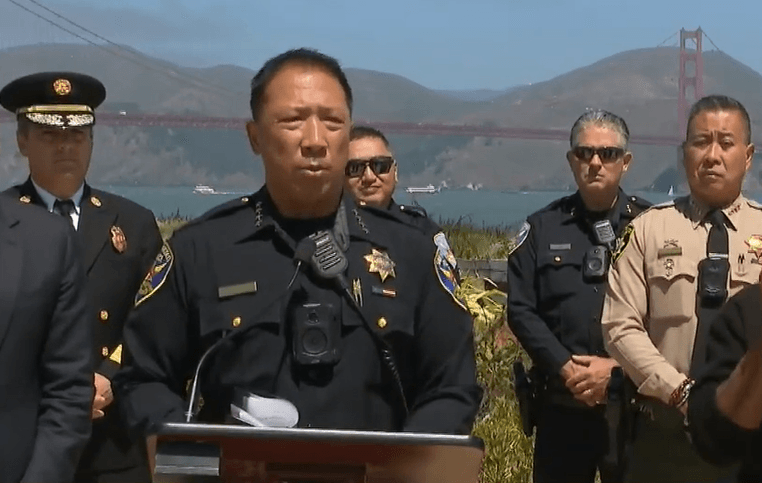
SFPD Chief Derrick Lew addressed the incident at a later press conference, saying, “We’re really trying to send the message: If you break the law in San Francisco, you will be held accountable.”
This didn’t sit well with Johnson, who pointed out that in addition to risking the safety of his family to protect property, he’s keenly aware of the many laws the state and city have chosen not to prioritize for enforcement.
“As a parent of a trans kid, the laws are broken against our children all the fucking time. Healthcare systems shut down care even though California law says they have to provide it. People try to deny our kids the right to play in their sports teams even though California law supposedly protects them. People harass and dox our children every time they put their heads out in public and nothing happens to them even though there are anti-doxing laws in California.”
When police charge a peaceful march, endangering families and children, that’s a political choice the police are making. When police are hypervigilant about property damage and blase about potential injuries to innocent bystanders, that is a political choice the police are making. When state authorities speak about the importance of law and order in the aftermath, while allowing trans civil rights to become paper tigers with no consequences for breaking them, that is a polical choice on the part of those authorities.
And when news media cover an incident, however unacceptable, where the only harm is that a politician has to leave an event, while failing to cover police violence against peaceful marchers, that is a political choice the news media are making.
I mentioned near the top that I wrote about the incident with Scott Wiener. I kept that mention brief, because I wanted to tell the story of police violence at Trans March, not the story of my having written an essay. However, the reason I’m writing this story now is because of my awareness that the news media who focused on the Wiener incident includes myself, writing for this very publication.
When I wrote about the incident, I didn’t know about this story, but it’s fair to think I could have, and should have. Antisemitism is unacceptable, and though there are people who insist the incident was not antisemitic, I haven’t changed my mind that dragging Gaza into unrelated disagreements with a Jewish politician requires pulling from a well poisoned with anti-Jewish thinking. I still feel we shouldn’t deny that, downplay it, excuse it, or ignore it.
However, calling out this antisemitism is complicated by the fact that we’re trapped in a culture where an accusation of antisemitism is considered more urgent and explosive than an accusation of inappropriate and excessive police violence towards a minority community. Those priorities are backwards. By writing about Wiener I contributed in a way I’m not entirely comfortable. If I had it to do over, I’d have written this story first, and the opinion essay afterwards, prioritizing the most urgent story for our community over the most viral one.


👏
Wiener is not some random Jewish politician but has been one of the most outspoken Israel defenders and has led harassment campaigns, got academics fired, passed censorship legislation, and has platformed islamophobia. his reversal in not genuine and he deserves every bit of heat he gets because once in congress he’ll be even more dangerous
I just find it odd that even in a place like this, a politician who wouldn’t possibly be more in favor of Trans rights than Wiener should be discarded because of ‘Palestine’ – one of the most hostile places on Earth to LGBTQ+ people. It seems odd that the priorities are such that nothing is more important than ‘Palestine’. It’s a good way to lose allies.