

When discussing a medical question, should we be guided by the evidence we currently have, or by fears and unproven hypotheses? In an Ideas column for the Boston Globe yesterday, writer Jennifer Block came down strongly on the side of vague fears and cautions. As in many essays of this type, Block provided no evidence that her many fears about youth transition were warranted, and no evidence that there’s any problem in the field of gender-affirming healthcare. Instead she asked readers to accept the proposition that there might be, and to support a change of course in the highly politicized field of gender-affirming care for youth on that basis.
Normally, the public would not need to weigh in on whether or not a promising medical treatment should be provided to more patients or fewer. That would be an area for the medical field to debate, for proposals, grants, studies, and hypotheses, and ultimately for doctors to discuss with their patients. Block makes no argument for why the public should involve itself, and recognizes the harm such involvement has already done to the LGBTQ+ community. Nevertheless she advocates strongly for the reader to take a stand on this issue, while providing no solid reasons why anyone should do so.
The real heart of Block’s essay is a question: What if it’s possible there’s a problem?
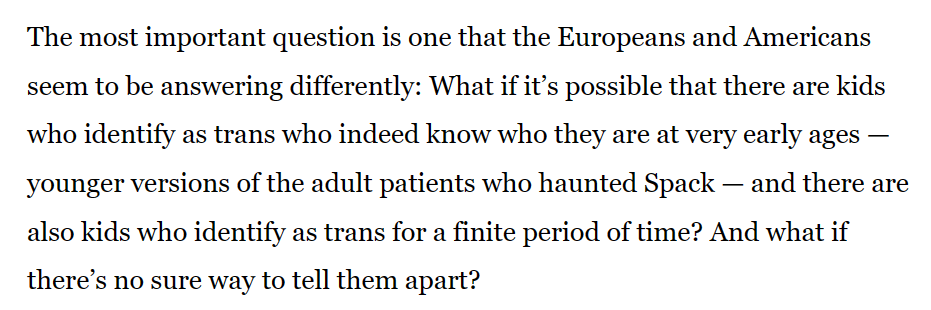
What if it’s possible… in the absence of evidence, wouldn’t the answer to “what if it’s possible?” be to wait for that evidence? For whatever reason, that’s not where Block’s going.
“What if,” Block asks, the doctors who watched incredible transformations among young trans patients just a few years ago were “seeing a sliver of the population?” What if, as treatment became more accessible, it began being overprescribed to patients who didn’t really need it? “What if there’s no sure way to tell them apart?” :Later she asks, what if a kid later comes to regret their transition?
These are questions that are entirely appropriate for medical research. If, for example, there was a rapid increase in the percentage of people who regretted their transitions, it would make sense to ask what steps could be taken to minimize that regret rate.
There is, of course, no evidence that this has actually happened. Instead of providing evidence that something has gone wrong in gender-affirming care, Block instead provides examples where the medical mainstream went wrong and changed course in light of new evidence.

Bock fails to provide examples of cases where a promising new treatment constituted a breakthrough, but of course there are many more such stories. When medicine has reversed case in the past, it has been in response to new evidence of harm to patients calling the current protocols into question. Block offers no evidence of harm outweighing benefit, overprescroption, or misdiagnoses, because she has none.
Instead of wrestling with the conundrum at the heart of this question: Why, if something is going wrong with gender-affirming care, has there been no evidence of increased regret, and continued studies that seem to show benefits? Instead, Block pivots to making her own question unfalsifiable. Quoting an interim report on a gender clinic in England that sought to rationalize the lack of evidence of increased regret or detransition rates in a heavily politicized process, Block asks what if prescribing treatment for gender dysphoria somehow locks in a trans identity.

Wouldn’t that be convenient? If somehow the treatment itself caused people with gender dysphoria to be trans you could never prove harm, because none of the patients would ever experience harm. No harm would ever be found because the only harm would exist in theory, in the possibility these patients might have done just as well if they hadn’t been able to access treatment.
It would certainly be convenient if that were the case, since it allows critics of youth transition to escape predictions made in the early days of this theory that regret and detransition would explode exponentially. The fact that a higher level of detransition and regret has never materialized is a perpetual embarrassment to those who have staked their careers on opposing updated standards in the area, so they press on, regardless.
In the medical arena, the most conservative approach would be to continue offering a promising treatment to youth who may benefit from it for now, watching carefully for evidence that suggested harm was happening to the patients, or that an alternative treatment would be more effective. After all, the greatest strength of science is to be willing to update our assumptions in the face of new evidence. However, this is not what Block advocates for; she’s not willing to wait for the evidence. Instead, she subscribes to alternative treatment model called “watchful waiting.”
In watchful waiting, the emphasis is on a lengthy period of therapy for all patients, with medical interventions reserved for the tiniest sliver. To qualify for medical interventions a patient must be so distressed that the need for treatment is overwhelming, but not so distressed that they exhibit serious mental health problems. This ensures that patients in the most desperate need have no chance at treatment, even if no other treatments have been successful. It also incentivizes youth who are relatively healthy to engage in just enough self-harm or suicide talk to be considered a good candidate for intervention.
Is there any evidence that watchful waiting produces better outcomes in patients than the gender-affirming model? Block cannot link to a single study that shows its benefits over the alternative. That’s right, in place of a model she complains doesn’t have enough evidence, she’s proposing a model for which she can provide no evidence whatever.
Advocates like Block, who feel strongly that transition must be limited to as few patients as possible, rely on it seeming obvious to the general public that fewer trans people would be better. The public is encouraged to forget that this is not the way medicine works in all other areas: When weighing the risks of treatment (which are real for every intervention), they need to be carefully balanced against the risks that come from not intervening. For trans youth those latter risks most famously include suicide, but also include institutionalization for suicidal thoughts or attempts, social isolation, hygiene issues, depression, and anxiety.
Given the evidence that does support gender-affirming care for youth, the questions Block poses are certainly ones that researchers should study and provide evidence for, but they’re also questions good science journalists should treat very skeptically until they prove out. Block is enamored with concerning possibilities (what if something is wrong?), but what should concern both the medical community and the wider public are actualities. It makes no sense to err on the side of letting a serious medical issue go untreated indefinitely merely because society prefers fewer trans people if at all possible. This is the hidden calculation within every such essay, and Block’s is no exception.





Yes! And the bias towards trying to have as few trans people as possible has always been the underlying theme: https://psycnet.apa.org/fulltext/2023-64773-001.pdf
This has much to do with the fact that minors who identify as trans are likely to become life-long medical patients. Desistance is preferable because it means less medications and less side effects. And that is the crux of the matter: “watchful waiting” i.e., explorative psychotherapy is associated with less adverse effects by virtue of the fact that it doesn’t involve medicalization. The author also omits other crucial points here: the notion that the risks outweigh the benefits for pediatric gender affirmation is precisely the conclusion of Swedish scientists based one their systematic review. Additionally, is the pro-affirmation side of the debate which is making grand claims about “settled science” and “no debate necessary”, not the other way around. Yet, the burden of proof falls on them when it comes to the cost/benefit analysis for these interventions. Yet, the European systematic reviews on pediatric gender affirmation highlight an issue with data collection pertaining to the adverse effects effects for these interventions as well as patient outcomes.
Don’t forget about the burden of proof and don’t forget about the conclusions of the systematic reviews currently available.
This is a weird comment. "Burden of proof" is a legal term, so what is it we’re not supposed to forget?
Certain specific European countries, none of whose systems or treatment models were anything like the US, have bowed to intense political pressure and put out statements about the evidence for a model they either weren’t using (Finland, Sweden, and Norway have always used watchful waiting), or was so hopelessly overburdened with years long waits for a first appointment (England) that it’s hard to conclude anythinbased on their outcomes.
In America, a promising new model, called gender-affirming care, has been shown to be associated with benefits to patients leading to a slow adoption of it in more hospitals. It’s not medication on demand, it’s just based on listening to the patient and not arguing with them while working with both the minor and their family to decide what, if anything, is best for that individual child. It does suggest social transition as a first step, which is by far the most marked departure from watchful waiting. Social transition involves haircuts, clothing, and pronouns.
The usual process for medicine would be that such a promising treatment would continue to be studied as it is adopted more widely, and then if there’s evidence of a better treatent or unexpected bad outcomes, it would be re-evaluated.
What you’re saying is that there’s some reason that normal process shouldn’t happen- that doctors should ignore the promising evidence and clamp down on treatment despite signs that it benefits patients and no evidence there’s a better option for treatment.