

Is it normal for a woman to experience endless mental distress over her gender? Soren Aldaco, a young detransitioned woman who is suing the medical professionals who once provided her with gender-affirming care, says yes. Aldaco, who authored an opinion column for the Dallas Morning News this morning, once believed that she was a trans boy. Now, however, she now believes that societal expectations for women were the cause of her distress. Notably, however, she does not say her distress has eased, or that she anticipates any end to it.
Aldaco’s story has been circulating in the right-wing press over the past two weeks or so after she filed a lawsuit suing the doctors who treated her gender dysphoria before her detransition. Many of the stories focused on claims of gruesome medical complications from a chest masculinization surgery Aldaco underwent when she was 19. The stories all set out a similar timeline: Aldaco began thinking of herself as trans as a young teen, during a mental health crisis at 15 she felt pressured by a doctor to talk about her gender identity and betrayed when the doctor shared the fact that she identified as male with her parents, she began cross-sex hormones at 17, had surgery to remove her breasts at 19. In the wake of complications from that surgery Aldaco came to believe that her transition had been a mistake.
Now 21, Aldaco writes that she believes the pressures to conform as a woman naturally result in women wanting to escape. She describes the euphoria she felt at each step she took to masculinize her appearance and presentation, and her belief that this euphoria was because she wasn’t forcing herself to conform to a woman’s gender role.
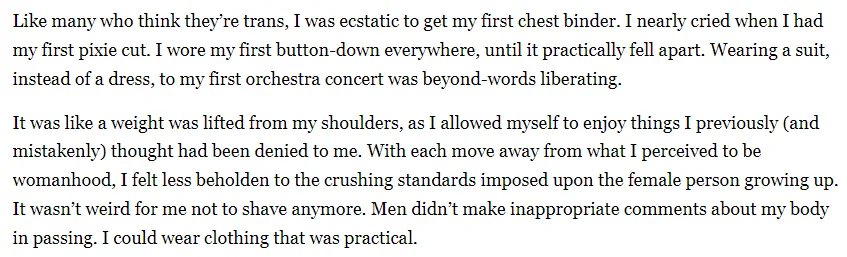
By highlighting the similarities between her experiences and that of trans boys, Aldaco seeks to underscore the point that she wasn’t misdiagnosed with gender dysphoria, but rather that people who experience gender dysphoria aren’t really trans. Does this mean that all women would feel “ecstatic” to wear a chest binder or a suit? Aldaco clearly believes that gender dysphoria is caused by patriarchy, but she never explains why so many cis women are able to express dissatisfaction with patriarchal gender norms and even rebel against them without reporting anything similar to this. There’s clearly something different about Aldaco and other female-assigned people who experience euphoria when they present themselves as boys or men (a tiny percentage of all the people who are AFAB), but she isn’t forthcoming about what that difference might be.
Aldaco also chooses not to offer any hope to people experiencing gender dysphoria that their discomfort might ease. Instead, she describes her chosen path as one of managing distress:

Here, Aldaco is conceding something that was first made public by ex-detransitioners, people who attempted to live as detransitioned women and gave up because it was too painful to fight a lifelong battle with themselves over their gender for ideological reasons. While alternative treatments for gender dysphoria are part of what the anti-trans movement promises, the reality is that people who choose to detransition often report an ongoing struggle with gender dysphoria. This is very different from the promise of gender-affirming care. Medical transition doesn’t have the ability to transform patients into another person or solve all their problems, but it does claim to drastically reduce or eliminate gender dysphoria from patients’ lives. Far from a lifelong struggle with gender distress, most trans people report major reductions in the specific symptom, gender dysphoria, that transition is intended to treat. (Dissatisfaction with transition is much more common among the minority of trans people who don’t experience that benefit.) Although it’s never touted as a cure for every problem, for many trans people the reduction in gender dysphoria brings with it a reduction in other negative mental healt symptoms such as depression, anxiety, and suicidal thoughts. (Here’s one of several studies that found this.)
“Listen to detransitioners” is a common refrain from activists opposed to medical transition, but when you do listen you often find that people who detransition do not claim to have been misdiagnosed, or even that their gender dysphoria has lessened through the alternative approaches they promote. Aldaco does not promise relief for sufferers from gender dysphoria, and has not experienced such relief herself. In place of relief she calls for widespread cultural change to make gender norms less onerous on women, but she does not claim that letting go of those norms for herself eased her distress.
There is no evidence that feminist cultural change will eliminate gender dysphoria, but even if it could it’s not clear why trans people experiencing gender dysphoria now shouldn’t transition in the meantime, while we wait for the cultural change that will do away with the need. It is Aldaco’s choice if she prefers to live as a woman who experiences constant distress over her gender, and no one should take that choice away from her. However, she does not make a compelling case for why any trans person should follow her lead.





I don’t understand the constant attack on detransitioners. Is they any pity in your heart for people who were medically damaged for the rest of their lives for no reason? You condemn the hate that transitioners receive, but spread the same hate toward detransitioners. Internalized homophobia and misogyny encouraged by dishonest therapists contribute to many of these problems.
What part of "It is Aldaco’s choice if she prefers to live as a woman who experiences constant distress over her gender, and no one should take that choice away from her" is hateful? There is a dearth of attacks, let alone "constant" ones, in the rest of the article, too.
It’s absolutely ok to examine both the motivations and the lives of people who advocate against a course of action they’ve taken and then changed their minds about. It’s where we get the wisdom that "crime doesn’t pay," and the advice to "look before you leap." But sometimes, we see that a person who changes their mind about something, then advocates for that original position, doesn’t seem to have a better life after all. This article simply points out that Aldaco’s life doesn’t seem to bear out the satisfaction that we would think would come from having renounced a wrong choice.
There absolutely probably are detransitioners who lead more satisfying lives for having detransitioned, but there are not throngs if them. There are, however, throngs of people who want to say that the existence of even obe regretful detransitioner means that no one should transition.
Don’t be one of them, Jason.
Your analysis of Aldaco seems a bit disingenuous. Not sure where you got the word "constant" from — it seems like she sees distress as a thing that comes and goes, like with most feelings. Instead of holding onto distress, she feels it then lets it go, which is a mindfulness principle.
Maybe Aldaco doesn’t state it outright, at least in this particular article, but if you pay attention to how she talks about her distress, she makes it pretty abundantly clear that her current framework lessens her suffering more than transition did. Maybe not her pain, because like most practitioners of mindfulness, she distinguishes between the two. But her mindset has turned things that previously felt unique and trying into honest facts of life. It has also blessed her with understanding, something that does help make pain less jarring and more manageable. This is a benefit we acknowledge with social transition, except social transition has the function of reinforcing sex-stereotyping instead of transcending it.
How will the cultural change come about, if people like Aldaco do not take the lead?
I will cheerfully accept the note that "constant" may not have been the best choice of words. I meant it in the sense that Aldaco doesn’t anticipate any time in the future when she won’t struggle with this, rather than that she feels it all the time.
This idea that social transition involves reinforcing gender stereotypes is always a red herring, because many trans people don’t conform to the norms for their post-transition gender. Nothing was stopping Aldaco from going against gender stereotypes by living as a feminine trans man, which is something many trans men do. If she was part of the trans community she’d have seen examples of that everywhere- refusing to accept gender stereotypes post-transition is a big part of American trans culture in 2023.
Aldaco is very young. So young that by my best reckoning I’ve spent approximately 5x as many years of my life living as a gender nonconforming woman pre-transition than she has post-detransition. This idea that she’s going to lead a cultural change by supporting the far-rights attacks on the queer community is absurd. If she believes it, it’s because she’s 21. It’s not the sort of serious position any adult needs to debate.
I still think you’re speaking in extremes here. It doesn’t look like Aldaco supports "the far-right’s attacks on the queer community" in the same way other detransitioners do — and I’d hardly call her article in the DMN "anti-trans" propaganda.
As a trans person myself, Aldaco has some valid critiques of American trans culture. Most of her platforming has been to establish nuance, call for more compassion, or discuss her personal case. I mean, she ends her DMN article with an acknowledgement that our world isn’t quite there yet. Conservatives need to hear that.
Aldaco might be 21, but I think you and I can agree that she’s far from stupid. Maybe it’s time we have some honest discussions with detransitioners. If we want them to stop turning to right wing media, we leftists need to do some bridge building.
Most detransitioners aren’t part of the right wing movement Aldaco has joined. The bridges you’re talking about have been built, perhaps you just haven’t noticed.
Aldaco, whatever her intelligence (and I’m perfectly willing to say she’s not stupid, just young and has no idea what’s going on), is part of a far right attack on the queer community. The lawsuit she’s brought is an ideological attack on all medical transition, and an extremely clumsy one.
The goal of the lawsuit and other suits like it seems to be first and foremost to keep driving the clickbait-y anti-trans news coverage Republicans think will helps them, distant second perhaps to make it impossible for anyone to transition by getting conservative judges to ignore the medical evidence and rule based on bias. There’s no attempt in the lawsuit to engage with the best practices in this sort of treatment and interrogate whether her doctors actually followed them, which would be foundational to a real lawsuit that was either trying to argue her doctors didn’t follow best practices or that the best practices are insufficient.
It’s not a serious lawsuit, which mans she’s not a serious person, and this is not an argument I’m willing to take further. Whether she means well or what her IQ is doesn’t matter.