

This article was revised and added to after publication. A commenter alerted us to a careless error made after looking through several poll results. We erroneously thought we’d included the most recent PBS poll in our story when the PBS poll we originally included was from 2021. We appreciate the comment and apologize that the original story fell short of our standards.
Late last year, the Washington Post partnered with KFF to conduct a groundbreaking survey, using representative sampling methods, to understand the lives of transgender Americans. At the same time, the Post surveyed cisgender Americans about their attitudes on transgender issues. Far from groundbreaking, cisgender opinion polling on trans issues has been done many times, by a range of outlets and polling organizations, including much more recent surveys than the Post’s from last November.
Yesterday the Post reported on the results of their November polling on mainstream attitudes about trans issues. Reporters Laura Meckler and Scott Clement presented the results as evidence that “most Americans support anti-trans policies favored by the GOP.” Here’s how the piece opens:

This is an extremely misleading framing for the Post’s survey data. It implies Americans were asked about their feelings on recent legislation by the GOP, and there’s nothing drawing the reader’s attention to the fact that this was done before that legislation existed. The dates the polling was conducted is mentioned in image captions and at the very end, in an italicized portion explaining the polling methods, but not in the text of the article. This misleading frame suggesting the polls represent support for the current legislative measures is particularly egregious because more recent polls, taken after the GOP’s 2023 legislative onslaught was better understood by the public, suggest that whatever Americans thought back in November, the anti-trans bills that have been introduced in legislatures across the country are not popular with the American public.
One of the most interesting poll results in recent months is that many Republicans may not support the GOP’s decision to make attacks on the LGBTQ+ community central to their agenda. That was one takeaway from a Data For Progress poll this past March, which asked how Americans feel about the legislative priorities of the GOP. A large majority of Americans (64 percent) and a majority of Republicans (55 percent) agreed that there has been too much legislation on trans issues.

Polling, of course, is an art and not a science. It’s well known that the phrasing of the question can influence the responses. The wording in the above Data for Progress’ poll is a bit leading, perhaps suggesting to respondents this might be a wedge issue and there might be too much legislation. In 2021, a much more neutrally worded poll suggested that Americans strongly opposed legislation to prohibit gender-transition related medical care for minors. A poll conducted by the PBS NewsHour/NPR/Marist found Democrats, Republicans, and Independents all united in their opposition to gender-affirming care bans.

This March, PBS found that support for gender-affirming care for youth has weakened since 2021, after an onslaught of anti-trans propadanda including in major news outlets. However, they still found that a majority oppose it.

The usual practice for news organizations is to avoid mentioning polling done by their competitors when presenting their own findings, so it’s not terribly surprising that the Post doesn’t incorporate this other polling in their story. Still, Post readers aren’t served by their reporters presenting stale findings as if they were more recent, particularly when more recent information directly contradicts the presentation of the findings in the Post’s lede and headline. At a minimum, the Post ought to have made it much more clear that the survey results under discussion took place before the current wave of legislation and could not be used to understand attitudes towards that legislation.
Given the relentless anti-trans propaganda from the US right, and the way that propaganda has been amplified by major US news organizations such as the New York Times and the Atlantic, it would not be terribly surprising if public opinion were to shift against transgender people. The data we have, however, suggests that the GOP may have misinterpreted confusion among Americans about gender-affirming care as support for heavy-handed measures to ban necessary treatments. The data the GOP used to shape their strategy likely resembled the Washington Post results from last November. More recent results give reason to believe that, despite all the misinformation and concern-trolling undertaken by major newspapers, Americans continue to oppose measures to ban gender-affirming care for youth who need it.
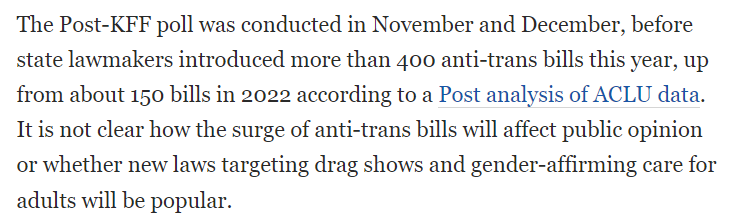
Update: At some point during the weekend, the Post added a paragraph explaining that the polling had been conducted prior to the current wave of legislation. We believe this change was done in part to the concerns raised by Assigned’s reporting. Here’s a screenshot of the new paragraph, which was placed about 1/3rd of the way into the article:





This objection to something as being "too old" includes something TWO YEARS OLD as an example of a good polling question showing the opposite of what is reported by WaPo. besides that, you quite falsely describe your first example as maybe being slightly leading, when in fact it’s EXTREMELY biased. Another problem here is that you have not said what kind of poll WaPo’s is, how lengthy, how many people were asked the questions, etc. It is quite possible for an extensive poll conducted on a large portion of the population to take months to complete and then do data analysis. By contrast, your two year old example gives the dates of a weekly poll, which would be on a small number of people.
I am sure you will skate all this past people who don’t know how to read studies, especially those who have no more than minimal ideas of how to check methodology for bias, but those of us whose professions include that will see right through the self-serving counterfactual bias you’ve used here in a complaint about "bad" results.
Do better.
This is a very good comment, one I actually think is worthy of my adding a correction to the story. I used 2021 PBS polling data, when I had looked at a lot of different polls and taken a bunch of screenshots, and used this thinking of a different March 2023 PBS poll. I’m going to update the piece and credit you for bringing this error to my attention. Thank you.
decent content of the comment, i guess, but the writing style is extraordinarily obnoxious. borderline impossible to get through due to the stratospheric cringiness.
Yeah "good" in my response referred to it being correct, not to it being nice. You don’t have to be nice if you’re correct (at least when pointing out issues with someone’s reporting), in my book.
Thanks for this article, I thought something seemed fishy with that WaPo article. It certainly helped add to my bad mood the other day. Happy to see this framing challenged.