
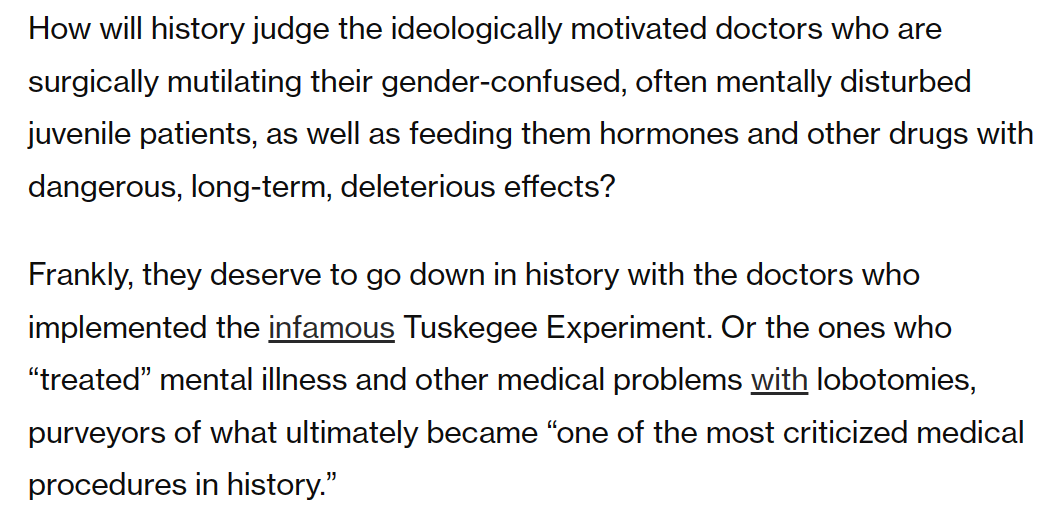
A story in the Daily Wire today invoked the dark history of lobotomy as a treatment for psychiatric conditions, warning that gender-affirming care is like lobotomy… somehow. The parallels don’t make a lot of sense, but it’s a comparison that’s been bandied about by anti-trans activists online for quite some time, so let’s look at the history of lobotomy and ask if there are any lessons to be learned in the realm of gender medicine today.
Lobotomy was a gruesome surgical procedure, initially developed in the 1930s, that involved severing the connection between a person’s frontal lobe and the rest of their brain. It became widespread during the 1940s in the U. S. and elsewhere after it was championed by a charismatic American doctor, Walter Jackson Freeman II, who believed the procedure represented a revolution in the field of mental health. Freeman developed a quickie version of the surgery that was performed with an icepick driven up through the patient’s eye socket and into their brain. This practice, which seems comically barbaric to a modern audience, didn’t require general anesthesia or the removal of part of the skull. The relative ease of performing this version of a lobotomy greatly helped it spread.
Lobotomies were incredibly risky, with a reported 14 percent mortality rate, and not all patients improved after receiving one. However, what makes them such a dark spot on the history of medicine is what was meant by saying many patients “improved.” Patients became placid and biddable with flat moods and few desires. In a context before psychiatric medications where patients were held indefinitely in hospitals where they were often subject to physical abuse to subdue them, lobotomy was viewed as more humane. Lobotomies swiftly lost favor when psychoactive medications were developed—when doctors had an alternative to spiking a patient’s brain with an icepick, they went with that.
So, how does the Daily Wire connect lobotomies and gender-affirming care? Incredibly superficially, as it turns out. A lobotomy is an outmoded medical intervention the authors know everyone thinks was bad, and they want readers to think gender-affirming care is bad and on the verge of being overthrown. It’s really that superficial: Medical treatment has evolved in the face of new evidence in the past, they want people to remember a particularly gruesome period in medical history, and they’re not worried about making it make sense.
Still, just because the Daily Wire is completely meritless as a publication doesn’t mean we can’t consider the history of lobotomies and ask if there’s anything in that history that might be useful to our thinking about gender-affirming care today. The first parallel that comes to mind is that lobotomies were done to make patients with psychiatric disorders easier for institutions and families to deal with. Instead of thinking purely of what was best for the patient, the needs of those around them came first. This is similar to the demands of parents who want some alternative to gender-affirming care that will make their trans child conform. The best interest of their child is secondary, for this group of parents, to things like religious doctrine, social acceptability, and their ideas about how their child ought to look and act.
Unlike lobotomy, gender-affirming care doesn’t come with a 14 percent risk of death, and it doesn’t turn trans people placid and make them easy to control. This is, in fact, the real source of the objections to transition from many on the right: They want conversion therapy to function like lobotomy, in the sense that they want a treatment that will stop people from wanting things conservatives don’t think they should want and behaving in ways conservatives don’t like. Of course, the harms of conversion therapy are nowhere near as serious and lasting as the harms of lobotomy, and it would be hyperbolic to claims the two things are alike. However, it’s clear there’s one side of the trans debate that has inherited the very attitudes that led lobotomy to become prevalent, and it’s not the gender-affirming side.





"Of course, the harms of conversion therapy are nowhere near as serious and lasting as the harms of lobotomy, and it would be hyperbolic to claims the two things are alike."
How many survivors of CT have you talked to? I mean talked to, and not just read things about us and came to your own conclusions about our experiences by yourself? As a survivor myself, who over 35 later still am living with PTSD and the harm it did to my core sense of self, autonomy and connection to others and the world, how that harm stole so much of my adult life from me, I can attest that the harm CT does can be life-long and profound that goes beyond those of us who are now unalived. No, it’s not the same as having your frontal lobe permanently injured, but I do not appreciate this downplaying of what trans and queer people like myself have endured. This is why many of us don’t want to talk about our trauma related to CT even with our own community, because people don’t listen and when they do, they want to twist what we say into something that’s easier for them to grasp and ultimately dismiss.
My CT was in the 1980s and even then practitioners of CT understood how harmful it was, which is why I was put in the suicide-proof room at the center I was at as a teen, because they knew what they were doing could very well drive me to that (and it did). With CT, the primary goal is to get the person to desist, but failing that, the secondary goal is to make them so broken that they cannot participate in society, often resulting in those individuals living with life-long health problems that keep them on the margins of society, including in and out of institutions from mental health faculties to jails and prisons, conditions that often lead to early deaths for far too many and less than optimal quality of life for many of us who are still alive.
And the kinds of people who support CT know this, because various kinds of deliberate harm has always been done to marginalized groups in order to keep them from fully participating in society (see Puar’s The Right to Maim). To them, making us less capable of being part of society is a "desirable" result for those of us who CT failed to make us desist, and this has long been one weapon used against trans and queer people to keep us marginalized and make is harder for us to participate in society as trans and queer people. I strongly feel the LGBTQ+ community has failed in understand this, both with the past use of CT and the current alarming surge in support of it among the anti-trans/queer movement. Please do not downplay the harms of CT.