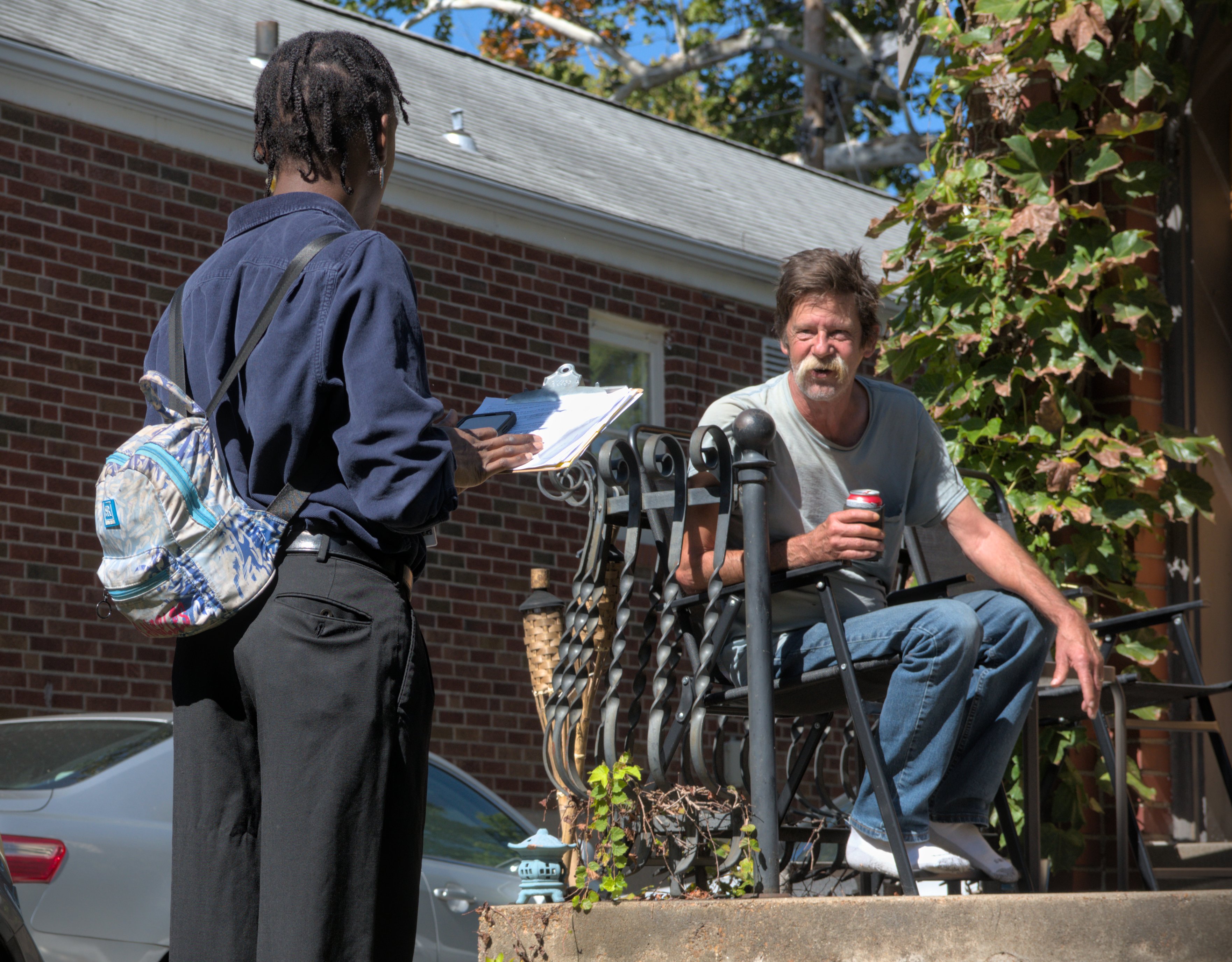
Te’ Hopkins approaches Paul Wissner on his front porch during canvassing in Richmond Heights on October 3 2026. photo by Piper Bly for Assigned Media
Paul Wissner says he “doesn’t have a dog in that fight” over transgender youth healthcare, but he did like the canvasser who talked to him about it at his home in Richmond Heights, Mo., one fall afternoon. He remembers her name too: Brittany.
“The girl who was here the other day, she was transgender,” Wissner told Assigned Media as our reporters observed a subsequent afternoon of canvassing in Wissner’s neighborhood. “I liked her. She was nice.”
Brittany is one of dozens of canvassers who have fanned out across five Missouri cities on behalf of PROMO, the state’s largest LGBTQ+ organization. They hope to persuade people to vote no on Amendment 3 in November, but also to do something a lot more radical than that: They hope to persuade voters that trans Missourians are their neighbors, that trans people are people just like them.
Amendment 3 is one of seven ballot initiatives across five states that seek to impose additional restrictions on transgender Americans. In part, it would amend the state constitution to ban the use of surgery, puberty blockers, or cross-sex hormones to treat transgender minors, all of which are already illegal under state law. However, in a twist unique to this measure, the proposed trans youth healthcare ban is combined with a near total abortion ban. And it comes just two years after Missourians voted to amend the state constitution to protect the right to reproductive healthcare.
Supporters of the measure have largely focused on trans youth healthcare, not abortion, in their campaigning. In response, much of the effort to stop Amendment 3 has focused on abortion, not youth trans care.
This may be understandable in conservative Missouri where 63 percent of voters told YouGov pollsters they opposed trans care for youth in 2023, rising to 73 percent for surgical care specifically. The poll showed even affirming talk therapy was highly contested, with 44 percent in favor and 44 percent opposed.
But those at PROMO believe they can convince voters to think again, using a playbook developed during the fight for LGBTQ+ marriage equality.
The Face of Yes on 3
The playbook of the Yes on 3 campaign is to downplay the impact of a yes vote on abortion, demonize providers of trans youth care, and sidestep the fact that such care is already illegal in Missouri. To do this, they’ve enlisted Jamie Reed, a former gender clinic staffer turned full-time anti-trans activist.
Reed has a well-documented history of bending the truth, a record that has been minimized in most media coverage. In 2023, she provided then-attorney general Andrew Bailey with a list of false or unsubstantiated allegations of wrongdoing involving her former workplace, a highly respected St. Louis clinic for transgender youth. Although an internal investigation by Washington University found the allegations to be unfounded and the external investigation initiated by Bailey never resulted in any action, Reed’s allegations succeeded in convincing holdouts in the legislature to support a total ban on youth trans care. Reed and her far-right allies claimed victory, and trans youth in Missouri lost their doctors.
Today Reed is the face of the Yes on 3 campaign, encouraging voters to ban youth trans care in one of many advertisements focused tightly on that portion of the measure.
In the ad, Reed claims she “saw how children are manipulated into irreversible surgeries.” Tellingly, this claim of children being manipulated into surgeries is nowhere to be found in Reed’s 2023 affidavit alleging wrongdoing at the gender clinic. (In written comments, Reed disputed this, pointing to affidavit sections 25-27 and 38–43. Neither concern children being manipulated into surgeries at her former place of work.)
No on 3’s Odd Org Out
Apart from PROMO, the No on 3 coalition seems largely uninterested in speaking publicly about trans youth or their healthcare. It failed to respond to requests for comment from Assigned Media for this and two earlier stories. Instead, its sole focus has been on the proposed amendment’s impact on abortion rights.
In response to local media, the campaign has been slightly more forthcoming, allowing some insight into how the coalition as a whole views trans youth healthcare.
“The facts are that healthcare for transgender youth is already banned in Missouri and it will remain banned no matter how people vote,” Tom Bastian, a spokesperson with the No on 3 Stop the Ban campaign told the Missouri Independent.
The website for Stop the Ban returns only one page hit for “trans,” an FAQ that reiterates, twice, that trans youth healthcare is illegal in Missouri and a vote on Amendment 3 will not change that fact. It also quotes the Kansas City Star, which called the transgender healthcare piece “an attempt to confuse voters into banning access to abortion “
The core coalition of the No on 3 campaign consists of four organizations focused on reproductive rights, a racial justice group, a DC-based labor-focused nonprofit, the ACLU, and PROMO. Of the eight, only PROMO has a primary focus on LGBTQ+ rights.
That focus can be seen in the four billboards the group is funding this election season. While billboards for and against abortion are easy to find as one navigates St. Louis, PROMO’s message for Missouri is to remember that trans people aren’t an abstract concept but real people living in the state. “Trans Missourians are your neighbors” it reads.
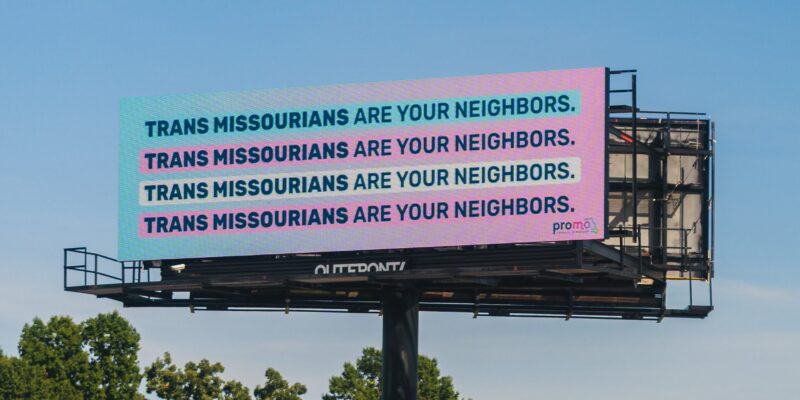
photo by Bryce Youngblood courtesy of PROMO
For the most part, PROMO staff were circumspect in discussing their relationship with their coalition partners. Still, some frustration with the official campaign’s concerted avoidance of trans kids boiled over in an interview with Sayer Johnson, who manages the intensive, or “deep” canvassing operation.
“It’s a disservice to us for these other organizations to not talk about us during this proposition because they’re going to keep using us as these herrings in this fight.” Johnson said.
While PROMO shares the short term goal with other coalition members of defeating Amendment 3, their campaign around it is very different. Its work is in service of a long-term goal: to change Missourians’ hearts and minds about transgender people and transgender youth. Unlike with other organizations, misinformation and fear around trans youth healthcare isn’t a side issue, they are main obstacles to achieving their vision of a MIssouri that welcomes and accepts trans people as their own.
The legislature’s passage of Missouri’s care ban in 2023 was a wakeup call for LGBTQ+ advocates that trans people weren’t understood or seen as neighbors by Missourians, according to PROMO communications director Robert Fischer. In response, the group developed a deep canvassing campaign, a project with quite a long time horizon by the standards of political organizing.
“Our five- to 10-year goal is building a pro-trans majority of voters in Missouri,” Fischer told Assigned Media. The deep canvassing PROMO is undertaking in opposition to Amendment 3 is part of that campaign.
Door-knocking for a candidate, initiative, or cause is a time-honored political pursuit. But deep canvassing, as the name implies, aims at deeper conversations between door knockers and voters. First used by LGBTQ+ organizations during the fight for marriage equality in the 2000s, the method seeks to engage voters’ empathy by asking them to talk about their own experiences as well as hear about the experiences of their canvasser.
In previous seasons, other legislation or initiatives have provided the framework around which conversations about trans lives were structured. What doesn’t change year over year is the long-term goal of creating a pro-trans majority in MO, or the strategy of using in-depth, one-on-one conversations to humanize trans Missourians in the eyes of their neighbors. The conversations take 15-30 minutes, and the target voters are people who are uncertain, meaning they describe themselves as neither completely opposed nor completely in favor of youth transgender healthcare.
PROMO on the Doors
To see the process firsthand, Assigned reporters piled into Te’ Hopkins’s boxy red Kia. On route, Te’ spoke about their reasons for joining PROMO as a field leader.
Until recently, Hopkins says, they taught 7th and 8th grade history in a majority Black school in St. Louis. That job had grown more difficult after they were caught between a trans student, who wanted to use an affirming nickname and pronouns, and the student’s parents, who forbade it.
They also felt they couldn’t bring their whole self to work, something that increasingly weighed on them.
“It would be an immense battle to teach in majority Black areas as a transgender teacher,” Hopkins says. “Parents wouldn’t trust me, and I don’t know if the school would have my back.”
In contrast, PROMO was a place where Hopkins says they can be their “full self” at work. The St. Louis office is diverse in both gender and race, with people of color in many leadership roles.
Once on the street, Hopkins taps on the doors with a friendly rhythm, then steps way back. Bringing their full self to work has drawbacks when it’s time to knock on doors as a nonbinary Black individual in a largely white neighborhood. They’re worried about seeming too aggressive, they say, a description that contrasts with their slight frame and pale blue and pink mini-backpack.
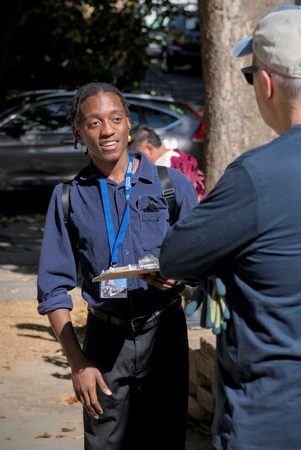
Te’ Hopkins speaks with a voter in Richmond Heights on October 3, 2026. photo by Piper Bly for Assigned Media
The afternoon starts slow, a dozen or more knocks that no one answers. Then Hopkins reaches the house of Wissner, a retired vehicle service tech enjoying a cold porch beer on a warm October afternoon. Wissner recognized PROMO from a previous canvass, and he had a lot to say about Amendment 3 (not all of it printable).
“They put the transgender surgery for minors thing on there when it’s already against the law!” Wissner tells Assigned Media. “I don’t have a dog in that fight—and I don’t think Jefferson City does either,” he added, referring to the state capital.
Wissner feels indignant at how the Republican legislature is seeking to overturn the voters’ decision on abortion just two years ago by linking it to trans youth healthcare. A similar anger at the way Amendment 3 links the two was repeated by many of the voters Hopkins spoke with that afternoon. But for PROMO canvassers, hearing that voters are with them in opposing the measure doesn’t end the conversation.
The point is to make a personal connection: Wissner, for instance, remembered Brittany talking about her struggles growing up transgender, which made an impression on him. It’s an impression PROMO is hoping will cause lasting change, and years of research on deep canvassing suggests it could.
Of course not every canvasser is trans. Cisgender canvassers share their personal experiences with trans friends or family. The intent is to connect with voters on a human level and put a face and a human story to the much-maligned concept of transgender children, one door at a time.
The work can be emotionally taxing. People look at door-knockers with suspicion, often giving a terse no or making an excuse to get away. On the afternoon shift Assigned Media observed, canvassers were assigned dozens of doors and the goal of two substantive conversations apiece.
At the PROMO office, this toll is balanced by intensive efforts to help volunteers and paid canvassers alike feel seen and heard.
“We’re creating the village we want to be in,” said Atem Richardson, St. Louis equality organizer for PROMO. Part of Richardson’s work involves a “Self Interest Training” aimed at helping canvassers deeply connect their own story to the work they’re doing. In the training, which Atem demonstrated briefly, they ask trainees questions aimed at surfacing their most deeply felt values and needs, and connecting those needs back to the work they’re doing to create sustained positive change for trans rights.
For Johnson, the deep canvassing campaign manager, this focus on developing trans organizers is the most meaningful part of the work. “Regardless of the outcome, we did that. Thousands of people – we talked to them,” he says. “There’s great power in this, in taking back the narrative and having people be able to tell their story and have it be important.” He hopes the campaign is “planting seeds” in the form of a new generation of organizers for trans rights.
In November, Missourians will vote, and Amendment 3 will either succeed in restricting abortion or fail. Either way, the ban on trans youth care will continue to hurt young people struggling with gender dysphoria in the state. Either way, organizers at PROMO will continue trying to convince Missouri that trans people are their neighbors, one conversation at a time.