As Monday July 20 came to a close, public comments about a Trump administration attempt to restrict trans gun ownership were overwhelmingly negative.
Citizens lambasted the proposal, which would require trans people to list their assigned sex on mandatory purchase paperwork even if that would conflict with their ID. Submissions called it “blatantly unconstitutional”, “government overreach”, and a clear attempt to further disempower a vulnerable minority.
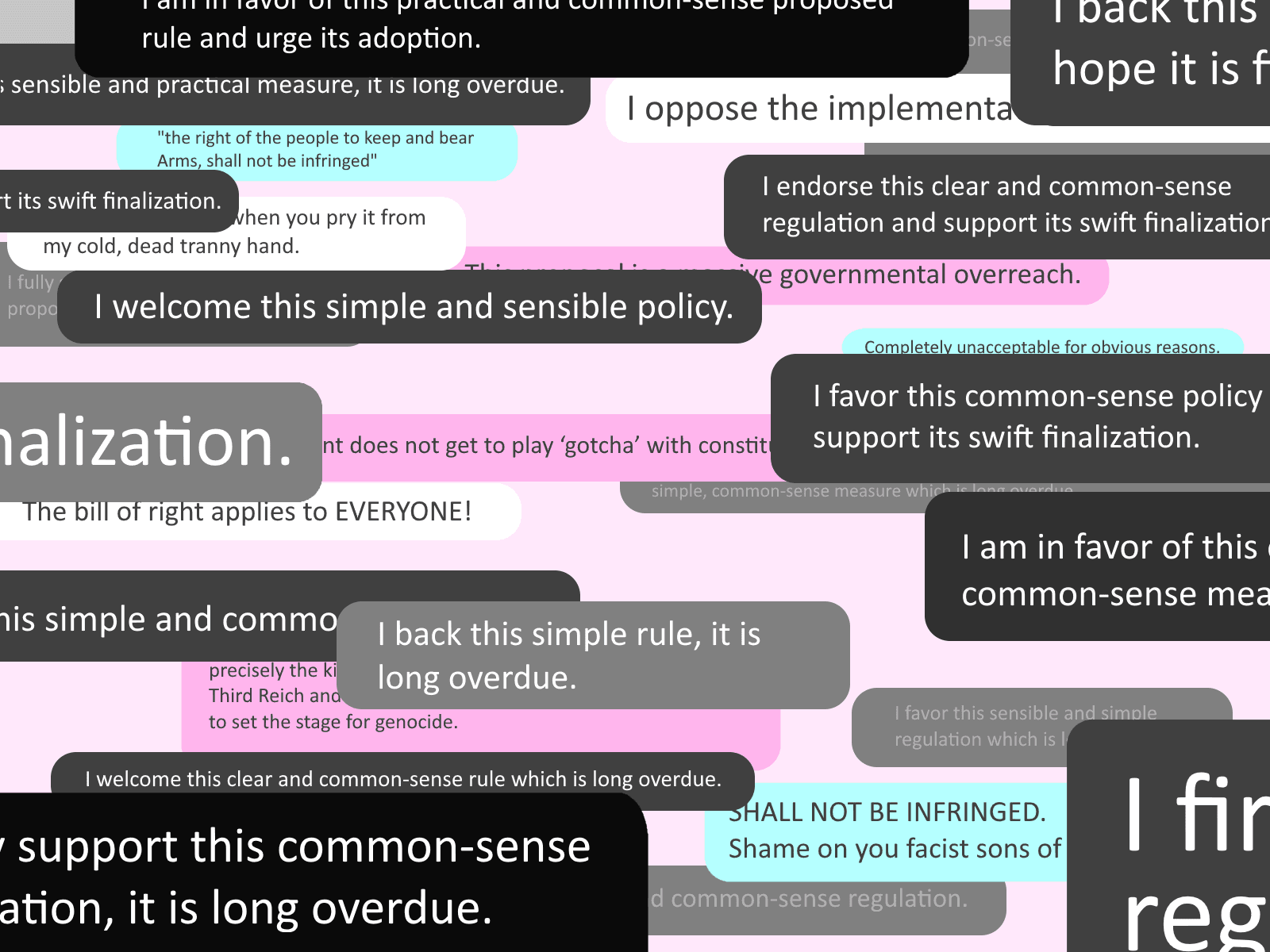
Then, practically overnight, the tone changed. On July 21, supportive comments began rolling in on an industrial scale — first dozens at a time, then hundreds. By the end of July 23, more than half of all comments were in favor of the new rule.
Nearly all of those comments show signs of being machine-generated, according to an investigation by Assigned Media — part of what appears to be a coordinated bot campaign that accounts for fully 96 percent of all submissions in favor of the rule.
“If I wanted to screw up astroturfing, it [still] wouldn’t be this bad,” Kate Gray, a Las-Vegas-based cybersecurity engineer who spotted the pattern while trying to do a sentiment analysis on the data, told Assigned Media.
“If it was an organization sending out [a template], what would happen is a lot of people would just copy-paste what they provided, and some people will modify a little or add things.
“They will not do Mad Libs, where they pick this word and that word and that phrase, but with the exact same punctuation, with the exact same spelling, and with exactly one sense. That is statistically impossible.”
Other Commenters Noticed a Suspicious Pattern
Gun rights activists have condemned the ATF’s plan as a backhanded attempt to scare trans people away from exercising their rights under the Second Amendment. Some trans gun owners have further expressed concern that the scheme would make it possible for federal agents to identify which gun owners are trans.
Making false statements on firearms purchase forms can constitute a felony, sometimes punishable by up to ten years in prison. The Trump administration has reportedly flirted with banning trans people from owning guns, while conservatives have often painted trans people as violent terrorists.
From May 15 until mid-July public comments on the scheme were dominated by trans people, allies, and self-declared gun rights supporters who urged the ATF to drop the proposal. On July 20, just 5.1 percent of submissions were supportive; within 72 hours, it had jumped to 54 percent.
Other commenters began to notice. “I’m writing to enter into the record that the comments submitted jumped from a little over 1,000 to 1,800 in a single day, and the bulk of those comments are the same comment with different names,” one anonymous commenter stated on July 24, describing the comments as “clearly fraudulent”.
A Simple Rubric for Every Comment Suggests Bot Use
The pattern was hardly subtle. In fact, in an age where AI has made it simple for scammers and disinformation merchants to generate large volumes of unique text, it’s surprising how similar these comments are.
“I support this common sense and simple rule and support its swift finalization,” reads one suspicious comment.
“I back this clear and common-sense policy,” says another.
“I favor this practical and common-sense measure which is long overdue,” reads a third.
You’ve probably clocked the pattern already. Each suspicious comment begins with a verb clause such as “I applaud…”, “I stand behind…”, or “I wholeheartedly support…”.
Next comes the word “this”, followed by one or two adjectives such as “simple” or (a clear favorite) “commonsense”.
Then comes a synonym for “policy”, such as “proposed rule” or “regulation”. Finally, an optional closing clause like “…and urge its adoption” or “…which is long overdue.”
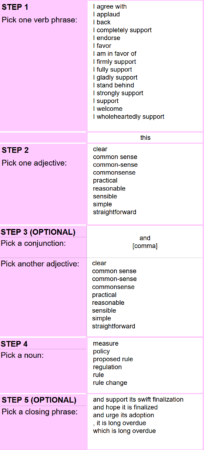
It’s so unvarying Assigned was able to capture almost every example with 60-lines of computer script, using a decades-old automated text-matching technique known as regular expressions.
2,072 comments matched our script exactly. Another ten comments were more ambiguous, but shared key words and phrasing with the others, perhaps representing the trial run or a first draft of the formula.
Assigned then checked all the non-suspicious submissions manually, tagging them as ‘support’, ‘oppose’, ‘neutral’, or ‘unclear’ in order to calculate what percentage were suspicious. (You can see the full data here, and the computer script here.)
“I don’t know who is doing it, although I obviously have ideas, but none of them can be substantiated,” Erin Palette, national coordinator of the LGBT+ gun group Pink Pistols, who has been sharply critical of the proposal, told Assigned.
“Regardless, the fix is quite obviously in, although they must not have faith in their side winning if they have to resort to a figurative packing of the ballot box.”
Fraud Likely, Proof Elusive
While fraud seems likely, it is impossible to prove these comments were fraudulent. In theory, they could have been submitted by real people using a random generator sent to them by a campaign group.
Public comments are a mandatory stage of the federal agency rulemaking process, designed to give voters input on policies that their representatives in Congress don’t directly vote for. While the results aren’t binding, officials are legally required to “consider and respond” to “significant” comments when making their decision (although the definition of “significant” is somewhat squishy).
Activist groups often send out templates and suggested wording for agency consultations, and copy-pasted responses can still be signs of real opinion. Palette herself sent her supporters a set of nine templates for opposing the rule.
But according to Gray, comments using templates are usually either completely identical to each other or modified in unique ways. Indeed, Palette’s templates, which she shared with Assigned, tell supporters that they “MUST RE-WORD” their submission by adding “personal touches” because officials are likely to ignore simple copy-pastes.
The resulting comments show various signs of messy human intervention, such as rogue spaces at the end of paragraphs. There’s also little regularity in how often each template was adopted.
By contrast, the suspicious comments never have trailing spaces, and their frequency is strikingly regular. After the first few examples, each opening — “I welcome”, “I applaud”, etc — appears almost exactly the same number of times (between 145 and 150). The same is true of those optional final phrases, which appear between 343 and 347 times each.
That evenness suggests an automated process picking between each option at random, akin to rolling a pair of dice hundreds of times — as opposed to human beings choosing which version to use.
The names attached to this batch of comments offer few clues to their origin. All are signed with a full name, rather than “anonymous”, but none give a city, state, or zip code. Of those names unusual enough to Google, many appear most prominently in online obituary pages, either as the deceased or as a relative.
Others match real people: a Second Amendment activist in Tennessee, an executive at a Texas bank, a software consultant in Seattle, a US Space Force employee in Virginia. Assigned has reached out to some of those people for comment and will update this story if they respond.
For Gray’s part, she wants to bring attention to the comments lest Donald Trump’s ATF try to claim that there was a groundswell of public support for its proposal, when in fact the opposite appears to be true.
It’s happened before. Back in 2017, during Trump’s first term, millions of fake public comments — some using the identities of dead people — were submitted both for and against repealing net neutrality laws. The repeal went through regardless.
“I don’t want the government to just be able to say, ‘we got two thirds of the comments in support for this common sense regulation’,” Gray told Assigned. “I want to try to cut that off.”
The ATF did not respond to a request for comment.
Io Dodds is a freelance reporter based in Berkeley, California who specializes in uncovering how tech platforms and other hidden systems shape our lives and culture. She spent eight years as a deep-cover drag king for the UK’s Daily Telegraph newspaper before coming out in 2021, and most recently served as a senior reporter for The Independent. Her first name is pronounced aɪəʊ (“eye-oh”).