
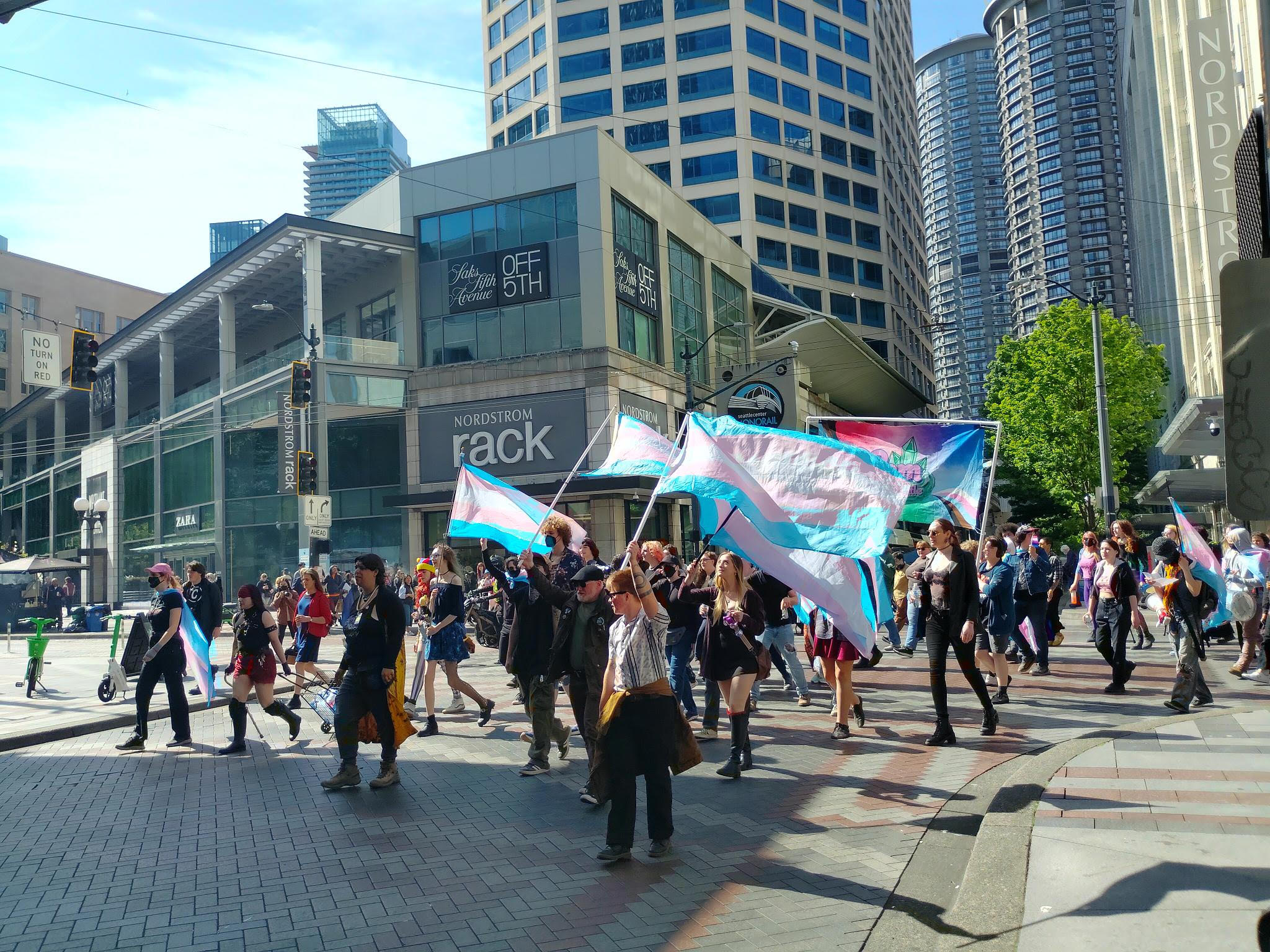
“It’s all broke trans people helping broke trans people.” The stress and exhaustion in organizer Violet Kawaguchi’s voice was palpable as she spoke with Assigned Media via video call about what she describes as a crisis facing new trans residents of Seattle and the people attempting to help them settle. As the executive director of the Kawaguchi O’Connor Initiative (or KOI), she’s part of a network of people working to support trans people fleeing the desperate ratchet of anti-trans laws and anti-trans hate during Trump’s second presidency.
Now, Kawaguchi says, those mutual aid networks are reaching their breaking point.
A Growing Crisis
Across Seattle, alarms are being raised about the desperate need of trans internal refugees and how that need is outstripping the resources of organizations who have been supporting them. Late last month, on Trans Day of Visibility, Seattle’s LGBTQ Commission (an officially sanctioned advisory body in the city), sent a letter formally recommending the Mayor declare a state of civil emergency and direct resources to help organizations dealing with the crisis, according to a May 12 story in Seattle Gay News. Mayor Katie Wilson’s response recognized the need for a coordinated effort to address the needs of recently arrived trans residents. However, citing budget constraints, she committed only to convening a team to evaluate the situation.
This past Saturday, May 23, a coalition of mutual aid groups followed up with a rally at Cal Anderson Park to try and inject a sense of urgency into the conversation over how Seattle can absorb the influx of trans people leaving their homes in red states. They feel the problem so far has been largely invisible, absorbed by nonprofits and informal mutual aid networks that have become strained to their breaking point.
“There’s no board of trans people helping trans people, so the full crisis isn’t showing up in the official statistics,” said Kawaguchi, “But if it’s not dealt with right now it will lead to a cascade collapse as community resources get expended and all the cases being helped by people in the community wind up being dumped on the city level resources like the shelters, city caseworkers, and things like that. And those are already overwhelmed”
“The transphobic laws kept coming” – Rose Legionaires
One recent transplant to Seattle is Rose Legionaires, a nonbinary trans woman, originally from Utah.
“I spoke, I wrote letters, but the transphobic laws kept coming,” said Legionaires, describing what it was like to watch the slow-moving disaster of escalating anti-trans laws play out in Utah. “I told people around me in 2021 that I believed Trump was going to be elected in 2024, and we had to be prepared to flee. People thought I was crazy, but I told them I think things are heating up in a way we’re not going to be able to come back from.”
In 2024, as bathroom bans began being implemented by red state legislatures, Legionaires and their partner determined to flee. They arrived in Seattle in early 2025, but the relocation process was not without complications. The couple set out believing they’d been approved for low-income housing, only to find, to their dismay, that the approval they’d received had been an approval to complete an application. Their life in Seattle began with the uncertainty of living out of cheap motels, their belongings in a storage locker, with no idea how long it would take to be approved for an apartment, or whether such an approval would even be forthcoming.
Luckily, they did manage to secure housing not too long after their arrival. With their basic needs met, they began connecting with the web of mutual aid groups and hosting other trans people who hadn’t been so lucky.
“We saw a lot of people who were struggling. We walk through the parks all the time, and people come asking – they need food, they need housing, they need clothing. I spent a lot of money out of my own pocket, making sure that people had these things, because there weren’t very clear resources we could access that could give people things as basic as good gender-affirming clothes.”
Legionaires also described a largely invisible form of homelessness mixed with survival sex work that can be found on local dating apps, where the profiles of some trans women will say they’re homeless and looking for someone who will to give them shelter. In the face of all this need, they and their partner have offered a succession of recent arrivals a chance to stay with them for up to 6 months, along with help finding jobs and navigating aid applications. Although they haven’t all been success stories, Legionaires proudly recounted the stories of two trans women who arrived with next to nothing, stayed for a while, and are now working and housed independently.
“We love helping each other. All we need is the ability to pay our fucking rent while we do it.” – Aspen Coyle
As the trans community has grappled with becoming a high priority target of the increasingly extreme Republican party, one way longtime advocates responded was by creating programs to help people in Republican-dominated states relocate. One such program was Project Open Arms, which was started in 2023 by TRACTION, a Washington State based nonprofit with a community service focus. Like KOI, they’re part of a coalition of trans advocacy groups calling for more help from the city to meet the growing needs of trans people who came to Seattle fleeing persecution. Assigned spoke with the Program Manager of Project Open Arms, Aspen Coyle, via video call.
“Our structure is a peer support model, matching up trans people who are trying to move with people who are there to help them,” Coyle explained. “These are people who are extremely isolated and extremely anxious, because they’re living in an environment that is hostile to their existence.”
The program does not supply direct support, but they help people plan a move and understand what resources are available. The volunteer base has grown from 10 volunteers in its early days to 70 more recently, and the influx of new people seeking support has grown commensurately.
Like Kawaguchi and Legionaires, Coyle has found the requirements of managing so many volunteers is starting to outpace her ability as the program’s a single part time contractor. She longs for another part time assistant or two to help her meet the moment.
“Historically, nobody has had our backs but us,” she said. “But mutual aid has definite limits when we are such a chronically underpaid and underemployed group of people. There are only so many couches.”
One of the couches in danger of not remaining available belongs to Kawaguchi herself, the executive director of KOI, just one of many who has thrown her time and resources into helping displaced trans people while herself struggling against housing insecurity. Though Kawaguchi focused on the needs of the community during her interview with Assigned Media, Legionaires mentioned that one of the leading figures coordinating mutual aid and financially supporting others has herself frequently been in fear of eviction. A subsequent web search turned up Kawaguchi’s GoFundMe.
Before attacks on the trans community became Republicans’ top legislative priority, it was already a group who faced tough barriers including family rejection, discrimination in housing, hiring, and in the workplace, higher rates of disability, poverty, homelessness, and unemployment, and lack of access to healthcare. These pre-existing issues have been exacerbated by the rush to leave red states for places where trans acceptance remains the norm and nondiscrimination laws still include gender identity.
Trans people are struggling to meet those needs, but as informal networks and nonprofits become overburdened the hope is that Seattle, and other blue city and state governments, will step in to help stave off disaster.
Evan Urquhart is the founder of Assigned Media.




Hey, I’m new here. Just wanted to say: THIS IS JOURNALISM and it’s appreciated.
Thank you for reading!!