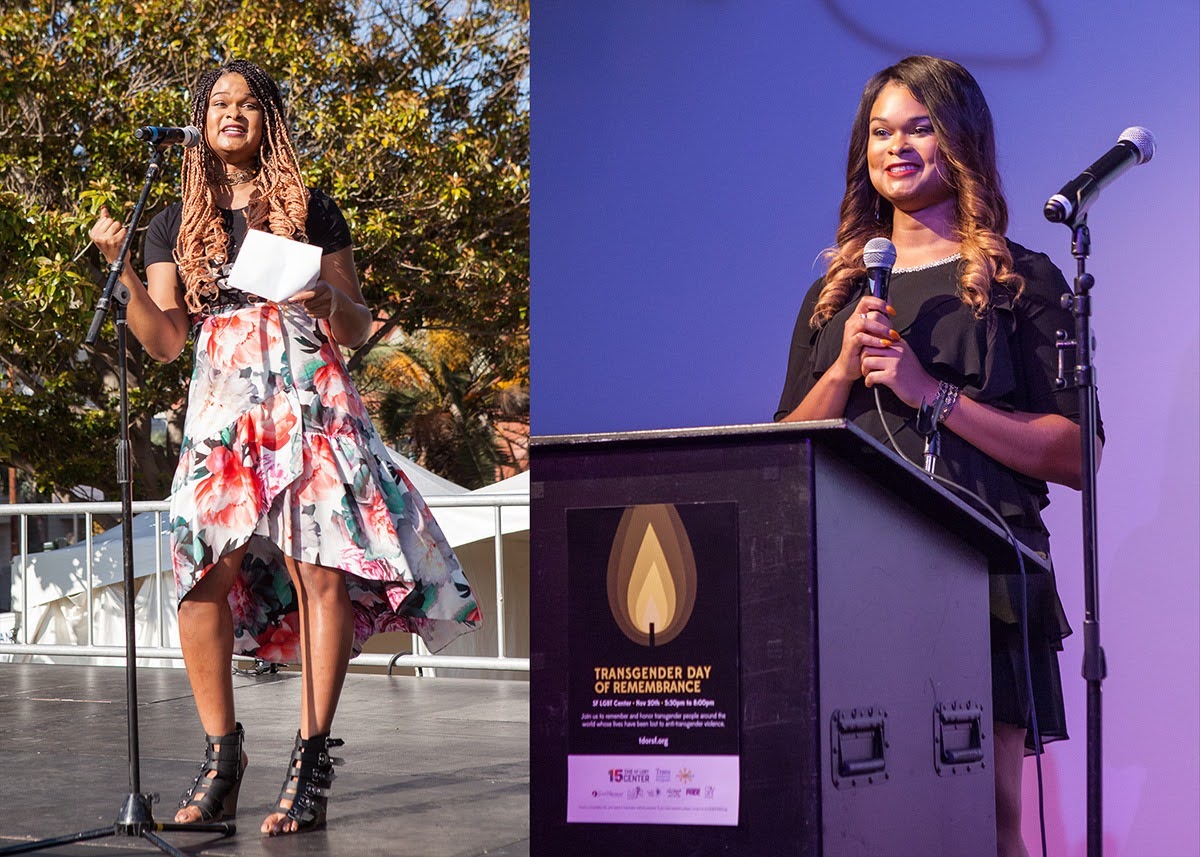
Photo: Raquel Willis speaking on stage at the 2017 San Francisco Trans March and Transgender Day of Remembrance. Photos by Pax Ahimsa Gethen, CC BY-SA 4.0.
In a society hostile to diversity and equity, Raquel Willis represents a trailblazing possibility model for Black trans activists. From her roots in Georgia as a journalism student and drag performer, she blossomed into a career of celebrating and advocating for the rights of trans and nonbinary people, Black trans folks in particular. For her tireless efforts, Time magazine named Raquel to their list of the 100 most influential people of 2025, and honored her as a Woman of the Year.
In 2023, Raquel released her first book, the memoir The Risk It Takes to Bloom. The paperback edition of that book came out this month. In the memoir, Raquel recounts her life from the 1990s through the year 2020, sharing intimate memories and candid thoughts on her lived experiences of gender transition, queer culture, race relations, feminism, activism, and more.
Raquel was born and raised in Augusta, Georgia. She recognized early on that she was queer, and tried to repress it at first, but endured bullying from classmates for acting too feminine. In a story that will likely be relatable to many trans folks, she first came out as gay, to the dismay of her traditional Catholic father. Though they did reconcile, she did not feel free to express her growing sense of womanhood until after his death during her freshman year of college:
“Slowly, those gendered expectations you instilled in me melted away, and the woman inside me was bubbling to the surface. Your death saddened me, but it also freed me.”
Raquel attended the University of Georgia, where she joined the student LGBTQ group Lambda Alliance, rising to the leadership of the organization by senior year. She began performing in drag, and joined a drag troupe that performed around the city. Her drag persona and support from fellow trans students helped her realize that she wanted to live full-time as a woman, and she began her gender transition. She was proud to graduate from journalism school under her new name:
“As soon as ‘Raquel Devoe Willis’ flowed through the air, I walked across the stage, proud that I had fought for my name, body, identity, and life so fiercely.”
At Raquel’s first job after graduation, reporting for a small-town newspaper, she opted to stay stealth. After moving to Atlanta in 2014, she connected with more social justice activists. She attended the first Movement for Black Lives convention, which, though challenging, she found “gave legs to an as-yet-undefined national Black trans liberation movement.”
When I first met Raquel in 2017, she was the keynote speaker at the annual Transgender Day of Remembrance event in San Francisco. Interspersed throughout her memoir are letters she addresses to the departed, including her father and several trans women who died by suicide or violence. She notes in the book that she was deeply moved by the suicides of trans teens Leelah Alcorn and Blake Brockington, which spurred her to be more outspoken in her activism.
At the time I photographed Raquel speaking at the 2017 TDoR and Trans March, she was working for the Transgender Law Center in Oakland, having moved there in 2016. In her book she relates how she and other Black staff members felt neglected at the TLC, despite there being many people of color in the organization. She made an important point that I have made myself, that “Black” and “PoC” are not equivalent or interchangeable. To help address the needs of Black trans women specifically, Raquel founded the TLC’s Black Trans Circles leadership development program.
The names of many of the Black trans activists Raquel mentions meeting in her book were familiar to me from my own advocacy work, including TransGriot blogger Monica Roberts, actress Angelica Ross, and community organizer Miss Major Griffin-Gracy, whose memorial I attended last December. I was also pleased to read that Raquel, like myself, came to support prison abolition, a cause Miss Major championed through the TGI Justice Project.
Following her work at the TLC, Raquel has had many achievements in advocacy. In 2017, she spoke at the National Women’s March, though organizers, shamefully, cut off her microphone before she could finish her planned speech. In 2018, she became the first openly trans executive editor of Out magazine, improving the publication’s representation of Black queer and trans women, which I appreciated as LGBTQ organizations often favor cis white gay men. She also won a GLAAD Media Award for Out’s 2019 Trans Obituaries Project.
After the publication of her memoir, Raquel co-founded the Gender Liberation Movement (GLM), which has held numerous rallies and protests. In February 2025, the GLM rallied for trans youth in Manhattan in response to Trump’s executive order against gender-affirming care. Raquel has been arrested while participating in several GLM actions, including a protest at the Supreme Court after the U.S. v. Skrmetti ruling in June 2025, and a protest for trans youth outside the Department of Health and Human Services this February.
As a writer, organizer, and advocate, Raquel Willis has many accomplishments under her belt, and shows no signs of slowing down. Her rooted persistence in the face of racism and transmisogyny is inspirational; I recommend her memoir to anyone working toward, or interested in, the cause of Black trans liberation. Raquel is holding conversations throughout the country to celebrate the new edition of her book; see her website for dates and locations.
Pax Ahimsa Gethen (they/them) is a queer Black trans writer and editor. They live in San Francisco with their spouse Ziggy.