
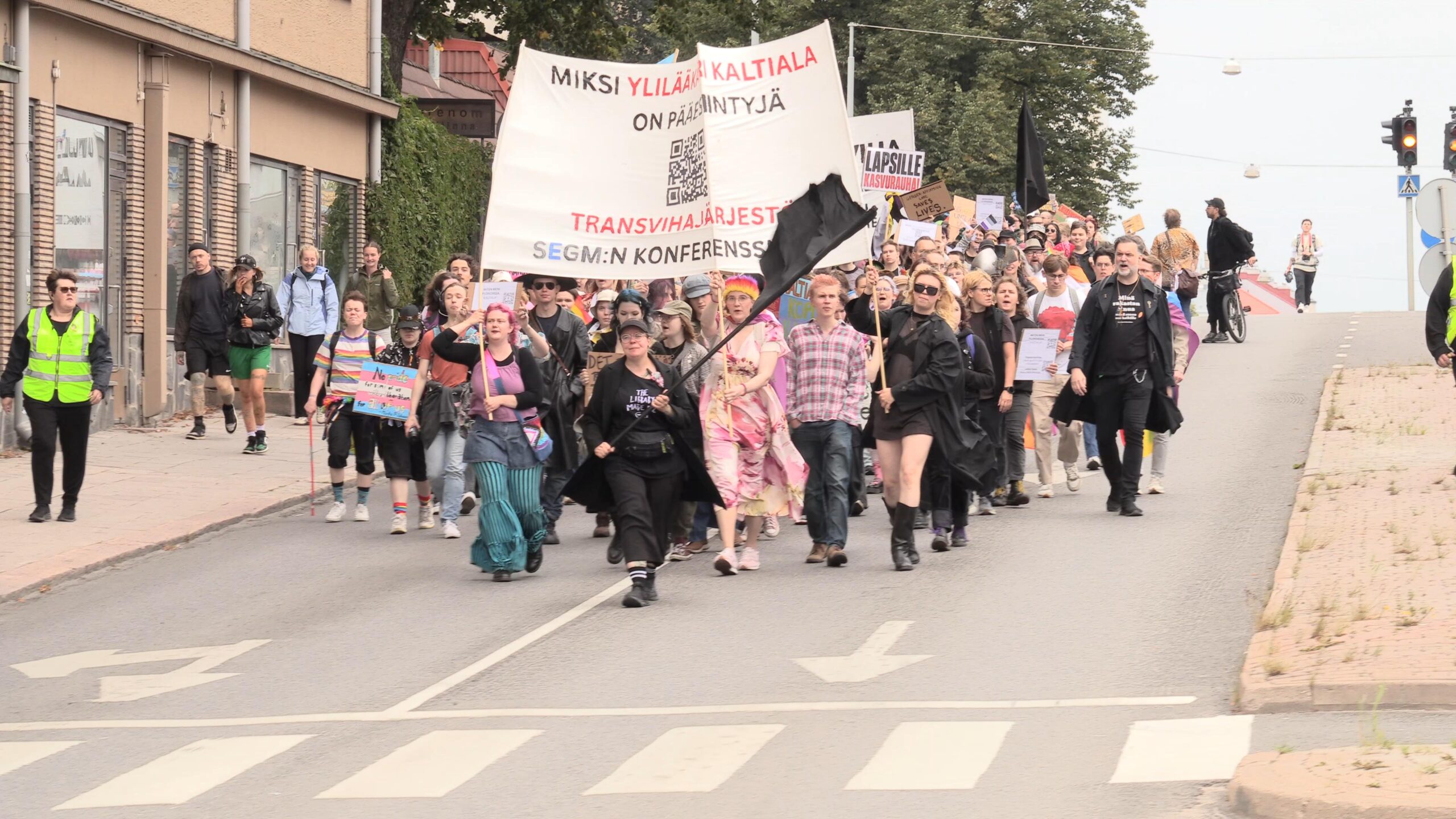
photo courtesy of Transpoli Vastuuseeen bloc
In Finland’s third-largest city this past Saturday, August 29, a group of roughly 200 protesters came together, forming a bloc within the larger Turku Pride March to protest bias in the trans healthcare system. Carrying signs and shouting slogans calling out the hated transpoli gender service, the protest is the latest in a growing movement calling for reform in gender care in Finland.
“Why is Chief Physician Kaltiala the main speaker at the conference for the trans hate group SEGM?” asked the large banner at the front of the bloc. “Down with transpoli! Down with gatekeepers! Down with Kaltiala!” the group shouted, joining the rest of the Pride marchers to proceed down one of Turku’s main boulevards toward Kupittaa Park, site of the Pride festival..
The action closely resembled that of marchers at Helsinki Pride this past June, where about 1,000 people participated in a transpoli protest bloc within Helsinki’s Pride March. In both cities the goal was the same: Protesters hoped to bring the public’s attention to the way Finland mistreats trans patients seeking help with medical transition.
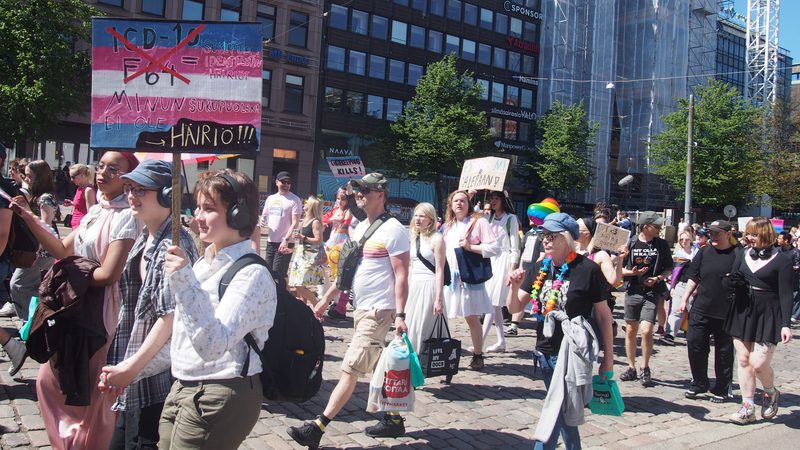
Anger at transpoli’s approach is widespread among trans Finns, according to activists who spoke with Assigned Media. This is backed up by a search for “transpoli” in r/transnord, the subreddit devoted to trans people in northern Europe. There, negative posts about the service abound and positive ones are hard to surface. However, until recently the unhappiness with how trans patients are treated had not boiled over into action.
In 2025, activists opposed to transpoli’s gatekeeping approach first formed a bloc within Helsinki’s Pride March. The numbers grew substantially this year, and interest in protesting transpoli appears to be growing, as evidenced by the satellite march this weekend. Organizers believe the protest during Turku Pride was the first time a demonstration against transpoli took place outside Helsinki.
This increased energy, they say, is in part due to the decision organizers made this year to directly name Riittakerttu Kaltiala and a select group of other doctors who have associated themselves with the international anti-trans movement. Criticizing doctors by name has been a controversial move in Finland, where the healthcare system and the doctors connected to it are accorded great respect. However trans organizers told Assigned Media they welcomed that controversy, which they credit with helping their cause finally attract attention from Finnish media.
“It created a lot of buzz in right wing circles on social media,” said Laura Salmenkallio, one of the organizers involved in the June protest in Helsinki. “Then our bigger media started covering it, as clickbait stuff. This was good. It grew and Kaltiala made a statement.”
Salmenkallio, who is part of a communist organization called Aurora Helsinki, spoke with Assigned Media via video call from Finland alongside Rae Reinvall of Trans ry, a more narrowly focused trans activist organization. The two agreed that causing offense among figures in Finland’s far right was key to garnering the attention needed for their message to reach the public.
In the US, the European model of centralized healthcare has often been seen as aspirational among those left of center. In Finland, activists value the positives of the system but consider trans care to be a black spot of ideological bias where doctors harbor deep prejudices against their own patients.
“It’s a complete outlier in Finnish healthcare,” said Reinvall. “We don’t have cardiologists talking against cardiology or cancer doctors talking against chemo.”
Assigned Media has previously reported on the lengthy, invasive, uncomfortable assessments trans young people are subjected to in Finland, assessments that seem designed to delay and deny treatment rather than serve the needs of the young patients. Organizers say while youth face the highest barriers, a similar approach is taken throughout the gender service.
“The care starts not from [the position] that you are a trans person who has dysphoria and should be treated. It starts from you are a cis person that has a weird gender incongruence and gender anxiety,” said Salmenkallio. “They want to rule out everything else. They want to see that you’re not depressed, no anxiety, neurodivergent, you don’t have trauma or anything.”
“You can’t even change the words you use to describe yourself,” said Reinvall. “So, you can’t go from calling yourself transmasculine to calling yourself a trans man.”
Any of these issues, as well as others, including not being able to find a job or not having a social life the doctors consider sufficiently active, can be used as reasons to deny or delay treatment without warning, according to Reinvall and Salmenkallio. Many patients have sought care abroad because care is so difficult to access.
The recent protests, and the responses to them, have given organizers new hope that change may be possible. While they stoked controversy, the protesters cheered when Helsinki Pride defended the right to call attention to the actions of public figures like Kaltiala. While nothing has shifted in the healthcare system itself, representatives of the medical establishment did meet with some of the organizers between the protests in Helsinki and Turku, indicating that some within the profession might be opening their mind to the groups’ criticisms.
Time will tell if that openness leads to reforms in Finland’s transpoli. For now, organizers say they’re committed to growing their movement and planning further actions.





So good to see! Love from Denmark!
This is what we need. It has taken way too long. I am so happy to see the unhappiness becoming visible.
Hopefully this movement can also come to Sweden, Denmark and Norway.