
A new study from Canadian researchers published in the Journal of Adolescent Health, has found young people’s gender identities are largely stable and medical steps taken during youth transition are rarely reversed due to a change in gender identity. The paper by Metzger et al adds to a large existing body of evidence that suggests the highly politicized concerns about misdiagnosis or rushed treatment for gender dysphoria in youth are not supported by available research. In fact, out of 445 patients, only a single youth who started hormone therapy later stopped treatment due to a change in their sense of their own gender.
Detransition is a highly politicized topic which is hampered by a lack of clear boundaries around what it does and does not describe. The Metzger et al paper uses the term sparingly, defining it as any person who discontinues a medical transition. In other contexts it has been used to include people who discontinue a social transition or more narrowly as someone who discontinues a medical transition after significant physical changes and also re-identifies with their birth sex. Although members of this last group are by far the rarest, detransition has come to mean a medical detransition and full reidentification with one’s birth sex in the public consciousness, contrary to medical and social science research, and helped by opponents of transgender acceptance.
For this study, researchers conducted a retrospective chart review of adolescents diagnosed with gender dysphoria at four Canadian gender clinics between 2012 and 2017. Of the 445 patients who were seen at one of the clinics, none were lost to follow up, meaning that information about every patient’s subsequent identity and transition status was available. Of the 445 13 adolescents(or just under 3 percent) returned to an identity associated with their birth-assigned gender.
An even more stark result, however, was the number of patients who returned to identifying with their birth sex after having started hormone therapy, which is a focus of widespread public concern because it can have hard-to-reverse changes. Only one patient of the 445 ceased hormone therapy while also re-identifying with their birth gender.
All other patients who returned to identify with their birth gender had never started hormone therapy in the first place, suggesting that hormones are rarely started for youth who are likely to regret the treatment. A slightly larger number, 3 patients in all, ceased hormone therapy for reasons unrelated to identity.
These numbers are dwarfed by the 68 patients who began treatment with a puberty blocker or menstrual blocking medication but did not start gender-affirming hormone therapy; and the 24 patients who were assessed but never started any medication.
Figure four in the paper shows the full range of outcomes for the 445 patients.
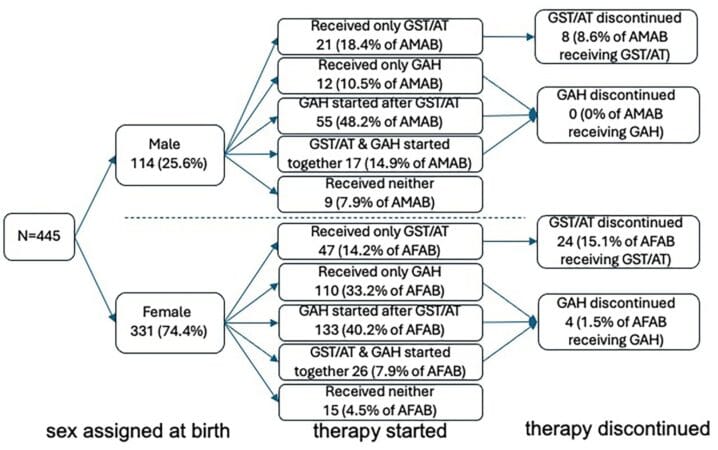
This research confirms what has been found before about the stability of young people’s gender identity and the rarity of detransition, particularly after significant medical steps are taken. Despite widespread beliefs to the contrary, medical evidence continues to suggest that youth treatments for gender dysphoria are offered with great care and negative outcomes are low compared to other treatments.