This story was produced in partnership with Important Context and the Accountability Journalism Institute.
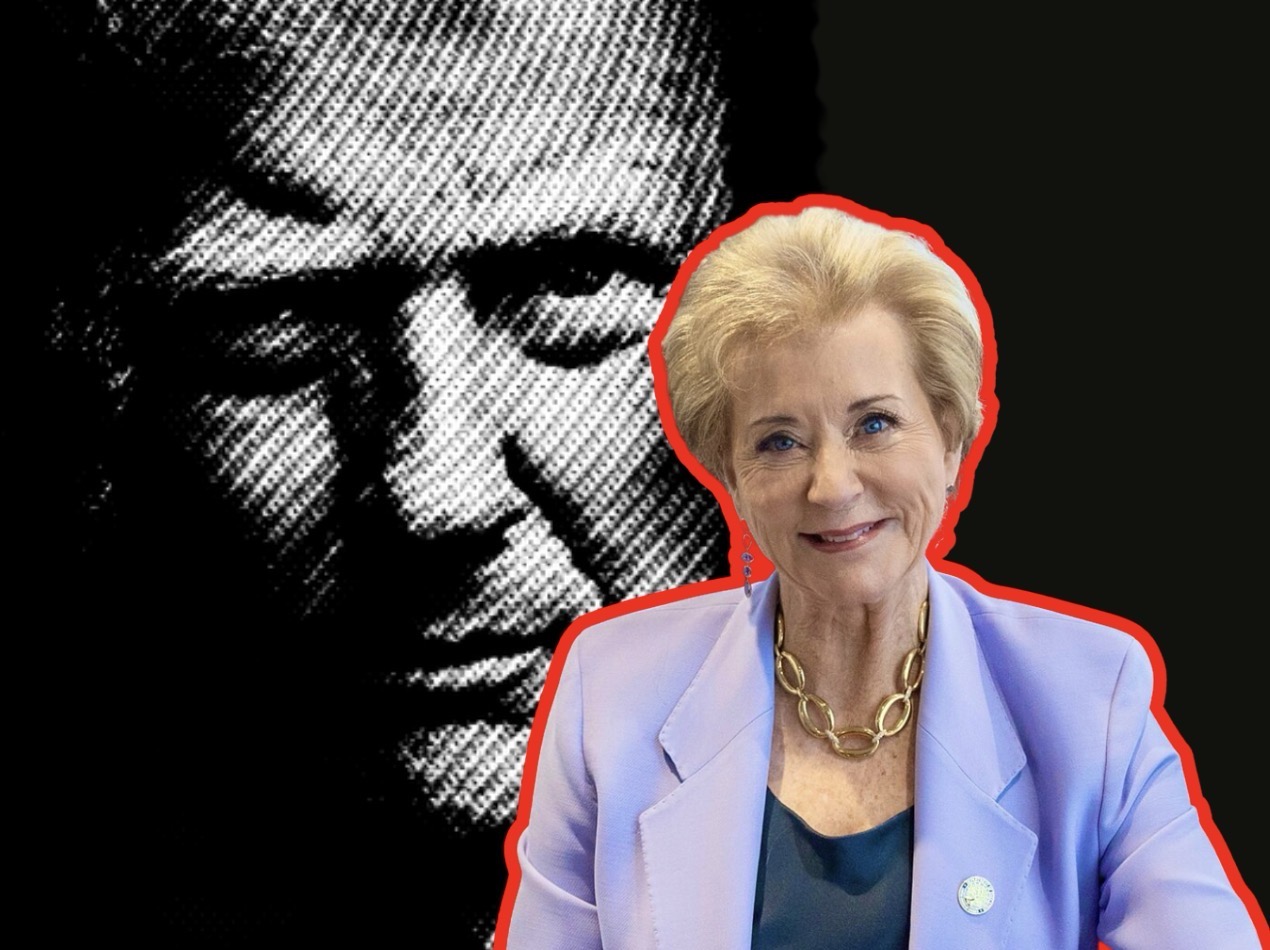
The intended headline was clear for Education Secretary Linda McMahon when she dropped her big announcement on Fox News and NewsMax late last month. Trans kids would be excluded from protections under Title IX, the civil rights act barring sex discrimination.
“It’s going to give women greater comfort, parents greater comfort across the country,” McMahon declared, echoing a familiar theme for the administration and right-wing groups: Anti-trans bias protects women and girls.
The reality, though, was far different. No rules were changed that day, Sept. 28, nor had they been changed since 2020, near the end of the first Trump administration. “It was this opportunistic anti-trans dog whistle to their base,” said Tracey E. Vitchers,” executive director of the nonprofit It’s On Us and an expert on Title IX.
McMahon’s announcement tried to underline that Trump was abandoning LGBTQ protections the Biden administration had wanted to put in place, though they had been vacated by courts more than a year earlier.
Unwittingly, though, McMahon also drew attention to another aspect of Trump’s 2020 rules: They had fundamentally changed the standards by which campus sexual assault and harassment cases would be considered in ways that favored men accused of misconduct and worked against women bringing complaints.
“It coincided with the Cornell case catching fire in the mainstream media,” Vitchers said of McMahon’s announcement. “The optics of that do not look good. When you look at the way that the Cornell case was investigated and adjudicated and the actions that Cornell took, they are directly tied to the very valid concerns that advocates and survivors raised about how the 2020 regulations could actually cause harm to student survivors and make it more difficult for schools to hold perpetrating students accountable.”
By the end of week, President Trump was saying that he felt “badly” for the men named in the Cornell case because a potential criminal case would be led by Letitia James, the New York State attorney general who has challenged a number of his executive actions. By then, the Cornell case, which involved allegations of gang rape and drugging, had enraged millions and thrust campus sexual violence into the national spotlight again.
From its 2020 rule-making to its seismic recent shift in national enforcement – an almost complete abandonment of sexual assault investigations in favor of anti-trans initiatives – the Trump administration has demonstrated that protecting women is not its actual priority.
The Cost of Sexual Assault
The administration and its right-wing allies like the Heritage Foundation have sought to pervert and undermine Title IX for some time, using it against trans students when convenient even as they take a hammer to its simple one-sentence promise of equality.
“No person in the United States shall, on the basis of sex, be excluded from participation in, be denied the benefits of, or be subjected to discrimination under any education program or activity receiving Federal financial assistance.”
Protections against assault are central to that promise, legal analysts say.
“Title IX addresses sexual harassment and sexual assault because it is a civil rights issue,” said Shiwali Patel, who worked in the Department of Education’s Office for Civil Rights from 2016 to 2018. “When anyone experiences sexual violence, it is going to have an impact on their ability to focus, to learn, to feel safe on campus.”
The regulations put in place by the first Trump administration, in 2020, “shifted the dynamics,” said Patel, now a senior director with the nonprofit National Women’s Law Center. “It’s created a more burdensome court-like hearing process. It’s also allowed an evidentiary standard that really tilts the scales in favor of respondents. In many cases, it’s respondents who’ve been able to afford counsel and complainants who haven’t.”
The Education Department, then led by Betsy DeVos, had calculated the cost in a telling way.
“When the 2020 regulations were created, in the preamble where the administration has to do its cost-benefit analysis, they didn’t consider the cost of sexual violence and the benefit of prevention, like creating safer campuses and supporting students,” Patel said. “But they did weigh in on the cost to schools and that this would mean that schools would conduct fewer investigations. So there would be cost savings. And sure enough, it has led to schools conducting fewer investigations.”
She added: “The other big piece of the Trump 2020 regulations is that it narrowed what schools can respond to.” Standards were altered at both ends of the process.
“The changes to the Title IX regulations in 2020 have definitely discouraged student survivors from coming forward,” said Vitchers, whose nonprofit seeks to prevent campus sexual assault.
“It was already extremely rare and challenging for students to report sexual assault and pursue Title IX investigations, even prior to the 2020 regulation being put into place,” she said. “We know from data that less than 10 percent of student survivors report sexual assault to their school, local law enforcement or other official body.”
A single word change tilted the balance as to what can be considered.
“Prior to the 2020 regulation, an incident of sexual misconduct or violence, had to meet the threshold of severe, pervasive, or objectively offensive,” she said. “During the 2020 regulatory change, they changed the ‘or’ to an ‘and.’ Just that change from ‘or’ to ‘and’ has created a barrier. The Title IX coordinator at the institution gets to determine if what happened to them was severe, pervasive, and objectively offensive enough.”
If a complaint clears that hurdle and an investigation is begun, the standard of proof is typically higher than it once was.
Under the 2020 rules that are in place today, “schools have the option to choose between either a preponderance of evidence standard, which is considered the best standard for student misconduct investigations,” Vitchers said. “Or they could choose a clear and convincing standard, which is very similar to a criminal case.”
“Many institutions have started to adopt a clear and convincing standard due to their own concerns about legal risk mitigation,” she added. “They were afraid of countersuits from respondents who may be found responsible under a preponderance of evidence standard.”
“We’ve also seen since that rule went into place, a wave of anti-male bias complaints being filed against institutions from men who are found responsible under Title IX for sexual misconduct.”
Putting Women on Trial
Though statistics vary, the prevalence of sexual violence on campus is astonishingly high even by the more conservative estimates of one in five women being victimized.
“We know that sexual assault is an epidemic on campus,” said Carolin Guentert, a lawyer with the firm Sanford Heisler Sharp McKnight who has represented women in Title IX cases involving sexual assault allegations.
The Obama administration, in an effort to get schools to take sexual assault and harassment more seriously, had issued a series of guidance letters to schools. Among other things, they counseled schools to adopt a preponderance standard and urged them against direct, live cross-examination.
Trump’s first administration, by contrast, undertook the lengthy process of formal rule-making before being able to set standards at the end of his term that were far more daunting for complainants.
Today, the determination process has become something akin to a court trial, Guentert said. “If there is an indication that an investigation needs to go forward, it goes to a live hearing with an opportunity for cross examination.”
“We’re talking mini-trials,” Guentert said. “Both sides have a representative, whether that’s a lawyer or an advisor. Evidence is exchanged. That evidence includes the kinds of things you would think of in a lawsuit — text messages, Snapchat, email. Witnesses give statements or are interviewed by the investigator. I’ve seen medical information and therapy records entered in these proceedings.”
The process, she said “can take many, many months, over a year even. We’re really talking about quasi-legal proceedings that just didn’t exist before 2020.”
For institutions, “This requires a lot of training and familiarity with the current legal obligations, and a lot of the time schools are not keeping up with the changing regulations.”
“Unfortunately, often the people who are in charge of taking these complaints, doing the investigations, or even making the decisions about Title IX complaints are not properly trained or, at the very least, are not trauma informed,” Guentert added.
The Cornell case illustrates the failures, both on campus and off, in protecting women’s safety and bringing just resolutions. The authorities chose not to bring criminal charges in the initial criminal investigation, which was recently reopened after public denunciations. A five-month-long Title IX investigation had resulted in two male students being expelled, and five being punished by suspensions, probation or having to write so-called reflection papers.
A month after Jane Doe filed a civil lawsuit, she was publicly identified on X, a platform known for misogyny and the exploitation of women, unleashing a social media mob that has endangered her and her family’s safety.
Targeting Title IX
While Trump has vowed to close the Department of Education, which oversees Title IX compliance, his close allies at the far-right Heritage Foundation have taken aim at the civil rights act itself.
“The current Title IX regime as applied to sports (and elsewhere) is part of a sustained social engineering effort that is designed to produce a new sort of woman—one that is more aggressive, more competitive, more male, less relational, and less oriented toward the goods of family and motherhood,” wrote Scott Yenor, a senior Heritage fellow and author of its July report, “Title IX’s Failed Experiment.”
The report focuses on athletics but Yenor makes his anti-feminist views clear. “History and the nature-denying extremism of today’s Title IX enforcement compel us to consider basic questions: What goods do women themselves get from sports and physical activity? What goods do men get?”
Yenor’s politically driven assertions about women’s athletics — for example, his astonishing claim they can lead to infertility — have been hotly disputed by some of the very scientists he cited in his report.
His comments over the years have reflected a broad agenda in opposition to women’s rights. In a 2021 speech before a conservative group, he said that women who pursue careers are “more medicated, meddlesome and quarrelsome than women need to be.”
More recently, in a February speech, Yenor declared, “We live under a regime of compulsory feminism, and that messes with the rank of what we expect out of women.”
“There’s no way out of family decline in America, or the birth dearth or however you want to register this problem unless we want to revisit this ranking in an intelligent way,” Yenor added in the speech at New Saint Andrews College in Idaho. The venue was not inadvertent: The college was founded by the Christian nationalist Doug Wilson, who has defended slavery and advocated for the repeal of women’s voting rights.
Yenor’s attack on Title IX is the latest expression of the Heritage Foundation’s hostility to women’s rights. Its Project 2025 initiative – funded in good part by six right-wing billionaire families—Bradley, Coors, Koch, Mellon, Seid, and Uihlein, according to the watchdog group DeSmog – provided the Trump administration with a blueprint to attack reproductive care.
The foundation’s 2026 report, “Saving America by Saving the Family,” rejects the no-fault divorce doctrine that helped enable women’s emancipation, pushes education aid restrictions that disproportionately affect single and low-income women; and celebrates a white Christian nationalist version of “God’s design.” It demonizes what it calls the “LGBTQ agenda,” most notably marriage equality.
The foundation’s influence on Trump has been profound. The administration is filled with anti-science ideologues, many of whom, as documented by the Center for Reproductive Rights, have worked for Heritage, appeared at its events or been platformed by allies in right-wing media.
Defense of Women: 0
Under Trump, the Department of Education’s Office for Civil Rights, or OCR, has abandoned its duty to protect women from assault and has instead targeted trans students, according to a report issued in April by U.S. Sen. Bernie Sanders of Vermont.
“OCR has done virtually nothing to protect survivors of sexual assault, victims of harassment, and female athletes denied equal opportunities under Title IX,” Sanders’ report said. “Instead, it has directed its limited enforcement resources almost exclusively toward investigating schools for their policies on transgender students.”
Sanders is the ranking minority member of the Senate committee that oversees the education department. His report describes how Secretary McMahon slashed the civil rights office’s staffing and its regional offices by more than half, while politicizing its work to target trans students.
“In one particularly stark example,” Sanders wrote, “the Trump administration replaced a 2024 OCR resolution agreement with Brown University that had documented anti-Palestinian and anti-Arab discrimination—removing those protections without explanation—and replaced it with an agreement focused on eliminating diversity programs and targeting transgender students.”
But perhaps nothing was starker than one data point that Sanders cited: zero.
In 2025, his report said, “OCR reached 0 resolution agreements involving sexual harassment, sexual violence, seclusion or restraint, racial harassment, or discriminatory school discipline.”
The civil rights office has sought to hide its lack of activity from public view, discontinuing its public database of schools being investigated. ProPublica filed suit to gain access to case data, and published its findings last week.
Although 200 complaints concerning sexual violence had been filed, the Trump administration began investigations in just 29 cases and faulted a school only once. Typically the office would open several dozen cases per year, analysts have said.
Last week, more than 125 civil rights organizations demanded that Congressional leaders intercede to fix this abandonment of women. Citing “horrific” accounts of failed investigations at Cornell and LSU, the letter writers said that “when schools do not respond appropriately, survivors are denied equal educational opportunities.
“Students, survivors, and advocates are exhausted and outraged to be dealing again with the epidemic of sexual violence in education with little accountability and little support for survivors.”
Amid this public outcry, the Trump administration has made clear what its priorities are regarding Title IX, and they have nothing to do with women’s safety. It is pursuing a new Title IX rule that would “direct federal agencies to recognize the existence of only two sexes, male and female, that are not changeable.”
Billie Jean Sweeney (she/her), a freelance journalist and advocate, is a regular contributor to Assigned Media and a board member of the Accountability Journalism Institute. She helped direct international news coverage for The New York Times and coverage of New York City for The Associated Press. She also served as editorial director of the Committee to Protect Journalists, where she defended international press freedom. At The Hartford Courant she led an investigation into the deadly use of restraints in mental health institutions. For Assigned Media, she’s written about the right wing’s attacks on trans athletes and how mainstream media adopted anti-trans disinformation.