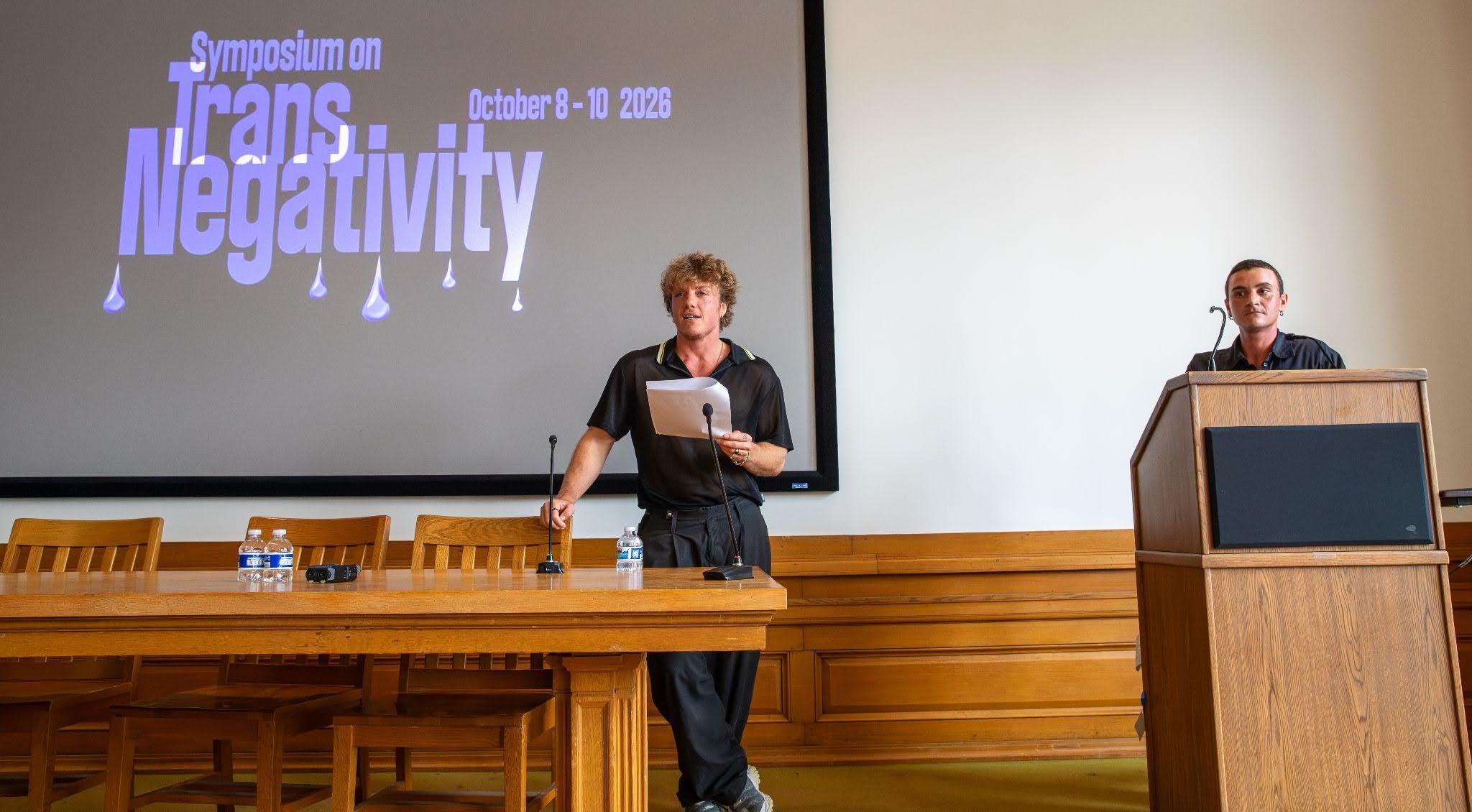
Cover Photo: Simon(e) van Saarloos and Be Schierenberg present at the Symposium on Trans Negativity. All photos by Pax Ahimsa Gethen, licensed CC BY-NC-SA 4.0. (More photos available on Flickr.)
Given the negative attention paid to trans people, how can we reframe and reclaim narratives of our existence? One approach: Rather than reject negativity, embrace it.
This month, trans and nonbinary scholars, authors, artists, and supporters gathered in the San Francisco Bay Area for the inaugural Symposium on Trans Negativity. The creation of Simon(e) van Saarloos and Be Schierenberg, both finishing up their graduate studies at the University of California, Berkeley, the free event featured three days of programming at UC Berkeley and The Lab, a San Francisco nonprofit that showcases underrepresented artists.
We “are constantly called to defend ourselves as real, good, scientifically proven, responsible, non-threatening” organizers van Saarloos and Schierenberg explained to Assigned Media. But doing so “also means that our language and tools are set and shaped by accusations, slurs, assaults.”
Absorbing rather than countering that negativity can allow us to celebrate being trans without feeling obligated to justify our existence, van Saarloos said. As an example, “negativity allows someone to demand access to hormones and surgery, without needing to prove that they will never be happy without them.”
The topics discussed at the symposium covered a wide range, as diverse as anarchitecture, ballroom, and spirituality. Speakers included: writer and academic Grace Lavery discussing her new book, Personal Demons, with PhD candidate Jessy Nyiri and scholar Ava Kim, co-founder of the Trans Freedom School; poet and academic Cameron Awkward-Rich reading from his collection, An Optimism; and artist, writer, curator, and professor Leila Weefur talking with author and academic Jack Halberstam about Leila’s exhibition, “The Chapel of Becoming.”
The panel discussions took place in a lecture hall on the Berkeley campus. In a moment likely relatable to many in attendance, one presenter shared in a pre-recorded video that she had planned to attend in person, but her long-scheduled gender-affirming surgery was pushed forward at the last minute.
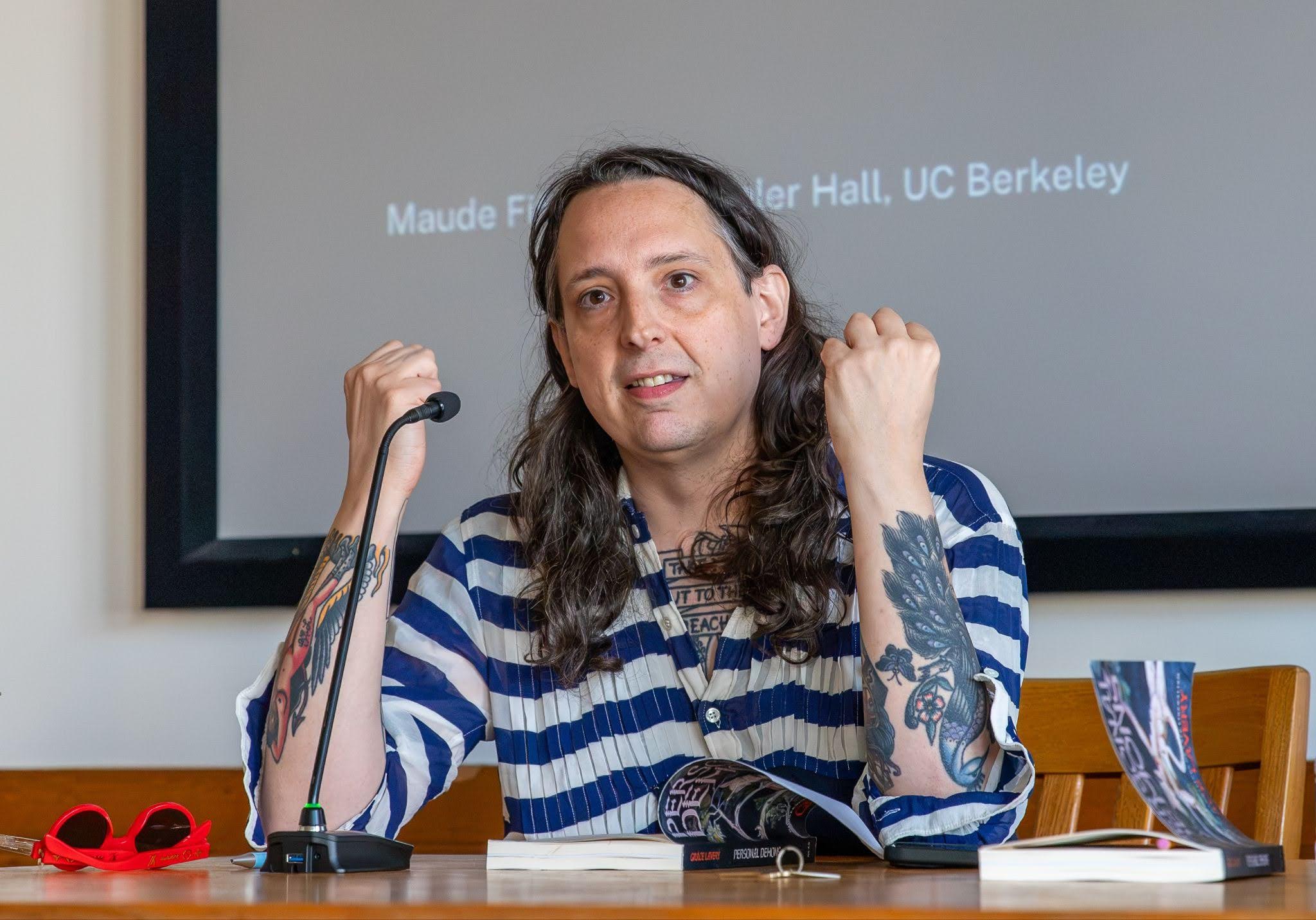
Grace Lavery speaks at UC Berkeley about her book, Personal Demons.
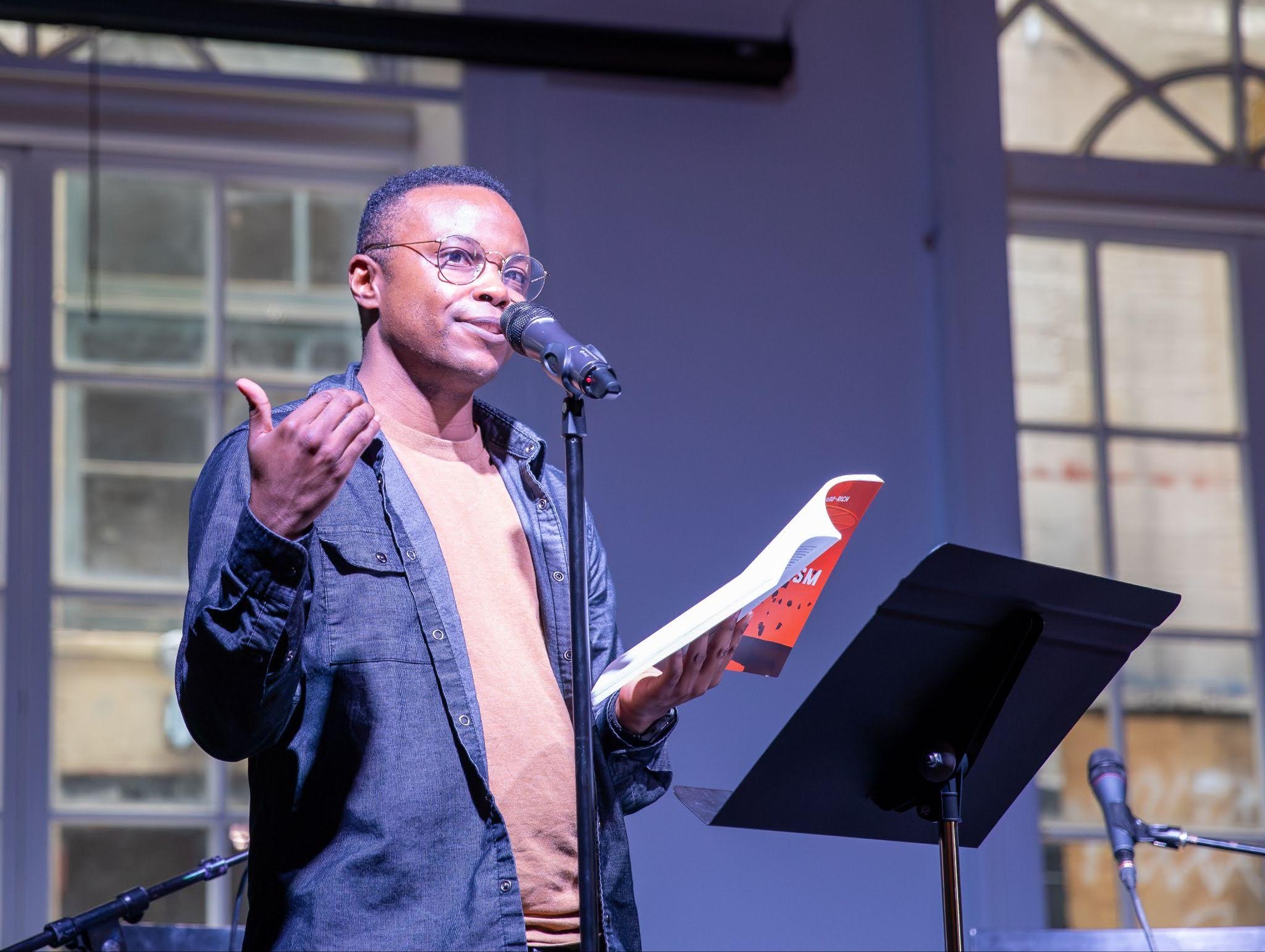
Cameron Awkward-Rich reads from his poetry collection, “An Optimism,” at The Lab.
Assigned Media attended the entire event, and reached out to the organizers and presenter Leila Weefur for their thoughts. (The interviews have been edited for length and clarity.)
Assigned Media: What motivated you to organize this symposium?
Simon(e) van Saarloos: Academic discussions in times of austerity and political scrutiny can feel very ‘pro vs con’, with different people defending opposing traditions, lineages and arguments. This can lead to a narrow way of thinking, in which you are either for or against – a theory, a school of thought, a scholar. As a field, trans studies has similar tendencies, often around the opposition between positivity, optimism, futurity on one side and negativity, antagonism, pessimism on the other. We wanted to organize a symposium around Trans Negativity, where speakers are not invited to resolve such a debate, but are asked to share their work, not in juxtaposition or opposition to others, but in the company of others. Differently put, we wanted to have some fun, but without optimism.
Trans scholarship and research are often pushed into representational work, showing the lives of trans people as real, excavating trans folks from the archive, proving trans people are worthy of existence, bringing diversity to do justice to the variety of trans lives. When this work on trans people by trans people is presented on stage, it can feel a bit embarrassing and cringe to be trans, because it produces a flattening narrative, nearly a promotional story of what trans is and can be, forever auditioning for humanity. We wanted the complexity of trans – trans as philosophy – to be forefronted.
Finally, trans scholars have very few spaces for intramural conversation, often lack access to proper mentoring, and are in need of networking opportunities.
AM: How did you recruit and select speakers for the symposium? Was it a lengthy or difficult process?
SvS: From the very beginning, we decided we would not strive to be complete. We didn’t want to make a list based on who supposedly shapes the field. Instead, we gathered a list of names based on rhythm – it needs to make sense but not too much sense, it needs to have dissonance and overlap. We made sure to include enough people with whom we have worked before, and people whose work we have only admired from afar. Every person we approached immediately said yes, apparently sharing our enthusiasm about negativity.
AM: Have you encountered difficulties securing funding for trans events and research due to the anti-trans federal administration?
SvS: There was the usual difficulty of securing funding within humanities departments and institutions, in which budget cuts and austerity are the usual. We reached out to many different departments within UC Berkeley and encountered a lot of support, though most were only able to contribute a small amount. We are both finishing our PhDs there, and work like this is unpaid and takes time from other jobs and opportunities. We were so lucky to have a group of volunteers to help us, too.
There are many successful trans scholars of course, but there are not nearly enough research centers, postdoctoral fellowships, and academic appointments for us out there. Even Berkeley is a testament to this.
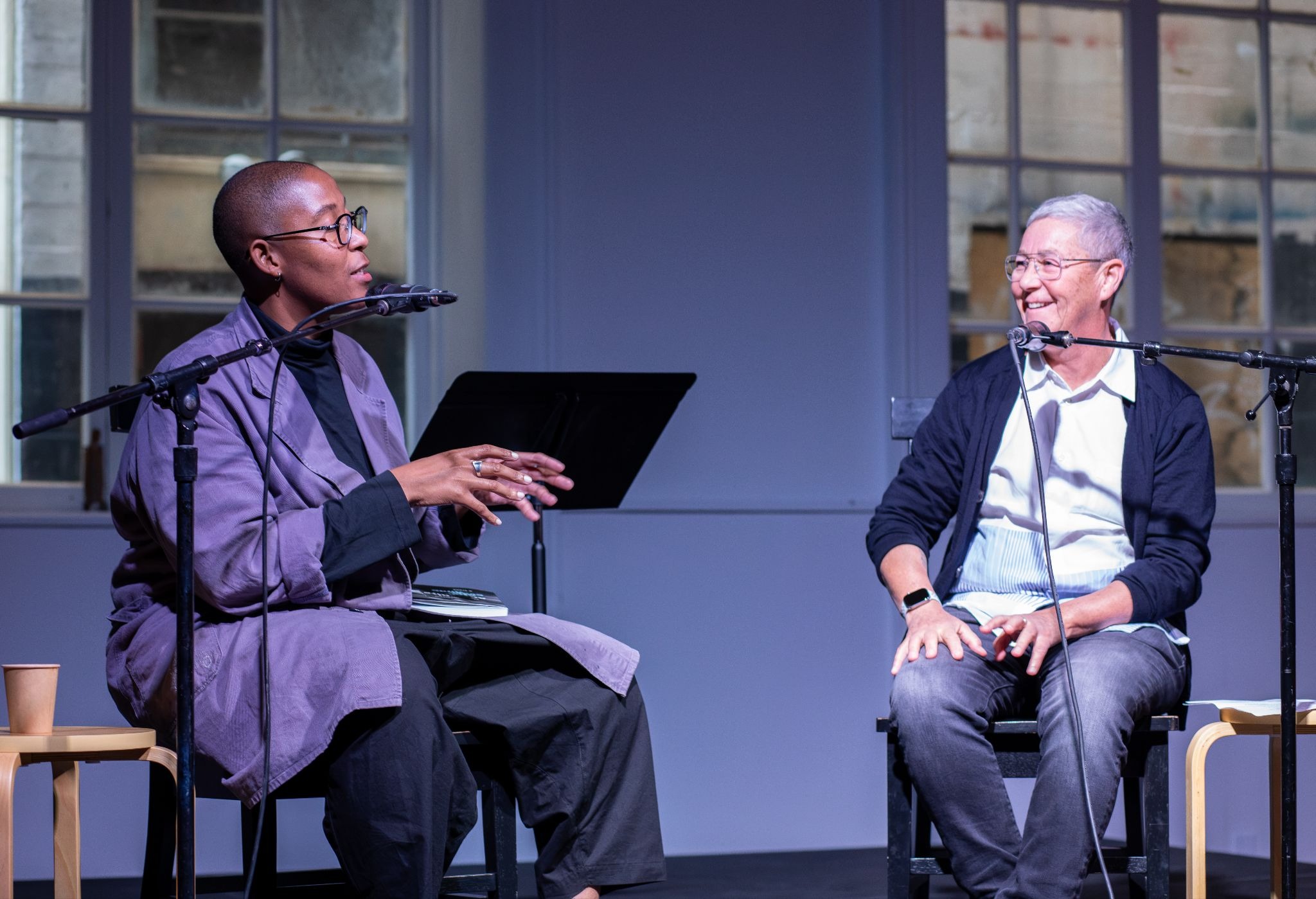
Leila Weefur speaks with Jack Halberstam at The Lab.
AM: How did you come to be involved with the Trans Negativity Symposium? How does your new work fit in with the theme of that event?
Leila Weefur: “The Chapel of Becoming” opened at The Lab in San Francisco on October 9, the same weekend as the symposium. The symposium was already bringing Jack Halberstam to San Francisco, and Halberstam’s writing on trans anarchitecture had been so foundational to the conceptual framework of the Chapel that the opportunity to be in conversation with him, in the space of the work, felt genuinely aligned. His argument that trans bodies are themselves architectural, that they unbuild inherited forms and refuse the structural logic of binaries, holding themselves in states of raw, unresolved becoming, is embedded in the Chapel at the level of its formal logic, operating as the grammar the work was built from.
Trans negativity, as a critical framework, names something the Chapel is also sitting with: the question of what becomes available when you release the demand that trans life be legible, affirmative, or resolved. The project proceeds by clearing away the architectures of exclusion and attending to what opens up in that clearing. It identifies what has made sacred space function as a structure of exclusion and works to take that apart, holding open what remains. That felt very much in conversation with what the symposium was thinking through, this shared orientation toward what trans life makes possible when it is allowed to remain on its own terms.
AM: How do you feel religious communities can best affirm and support trans people?
LW: I want to push back a little on the word “affirm” and the framing of the question itself, which implies the goal is to problem solve on behalf of the institutions and the religious communities they serve. The Chapel came out of my own experience of being excluded from spiritual communities, and I want to be clear that I carry a deep and genuine relationship to religion and religious practice, which makes that exclusion something I feel in the body, not at a distance. This paradox is not abstract. There is a real complexity in belonging to a tradition that has also been a site of harm, in loving something that has made you understand your own presence as a problem, and the Chapel sits inside that complexity rather than trying to resolve it. What Halberstam calls dispossession is the framework I keep returning to here, because the exclusion of trans people from spiritual communities is a forced dispossession, a severing from something that was never offered as a choice.
Trans people have been building devotional life outside of sanctioned religious structures for as long as we have existed, in improvised and informal acts of devotion carried in the body, in community, in the spaces institutions abandoned or refused. The Chapel of Becoming is built for the individual who has learned to find the sacred in those spaces, and learned to carry spiritual life in forms that required no institutional permission to be real. So the question for religious communities is really about whether they’re willing to be changed by what we’ve already built, which requires something more demanding than affirmation. It requires a genuine reckoning with the ways their structures have functioned as instruments of exclusion, and a willingness to learn from the devotional practices that flourished in the spaces beyond their reach.
AM: Have you encountered difficulties securing funding for your work due to the racism and transphobia promoted by the federal administration?
LW: This project was fortunate to find support through The Lab’s sustained commitment over nearly two years, and I worked closely with Andrew Smith, the executive director, to develop grant strategies that could meet the ambition of what I was trying to make, which meant being creative about funding models and pursuing less conventional paths. I tend to work with spaces like The Lab precisely because they understand that ambitious work often requires unusual structures to support it, and Andrew’s willingness to think alongside me about what this project needed was essential to its realization. The broader climate shapes all of this, of course. The systematic pressure on arts organizations, the compounding of institutional risk-aversion in a moment of political hostility toward queer and trans life are conditions every artist working in this space is navigating, and the labor of finding pockets of support has become its own full-time practice running alongside the actual making.
AM: What are your thoughts on the risks and rewards of being visible as a trans person in the U.S. today, particularly for a Black trans person?
LW: The most immediate reward I can name is the classroom. I’m an assistant professor at the University of Washington, and I’ve taught across the Bay Area, and when I walk into a room full of students, many of whom have never had a professor who looks like me or moves through the world the way I do, something shifts that I find genuinely difficult to describe but that is deeply felt. That shift creates the conditions for students to be fully themselves, to bring the complexity of who they are into their intellectual and creative practice, knowing they are seen and respected. That impact grounds everything else I do.
What I carry alongside that is the weight of knowing that visibility for a Black trans person in this country right now is a daily calibration and necessitates an ongoing reading of what is safe and what is possible. The doors it opens are real, and so is the exposure that comes with opening them, and those two things land differently depending on who you are and what you’re carrying. I make this work because I understand that liberation requires the willingness to be seen, and I hold that willingness alongside a clear-eyed awareness that being seen as a Black trans person in this country means being legible in ways that also make you a target. I make the work anyway, because to retreat from that visibility would be its own kind of loss, and I am willing to practice that disappearance.
Pax Ahimsa Gethen (they/them) is a queer Black trans writer and editor. They live in San Francisco with their spouse Ziggy.