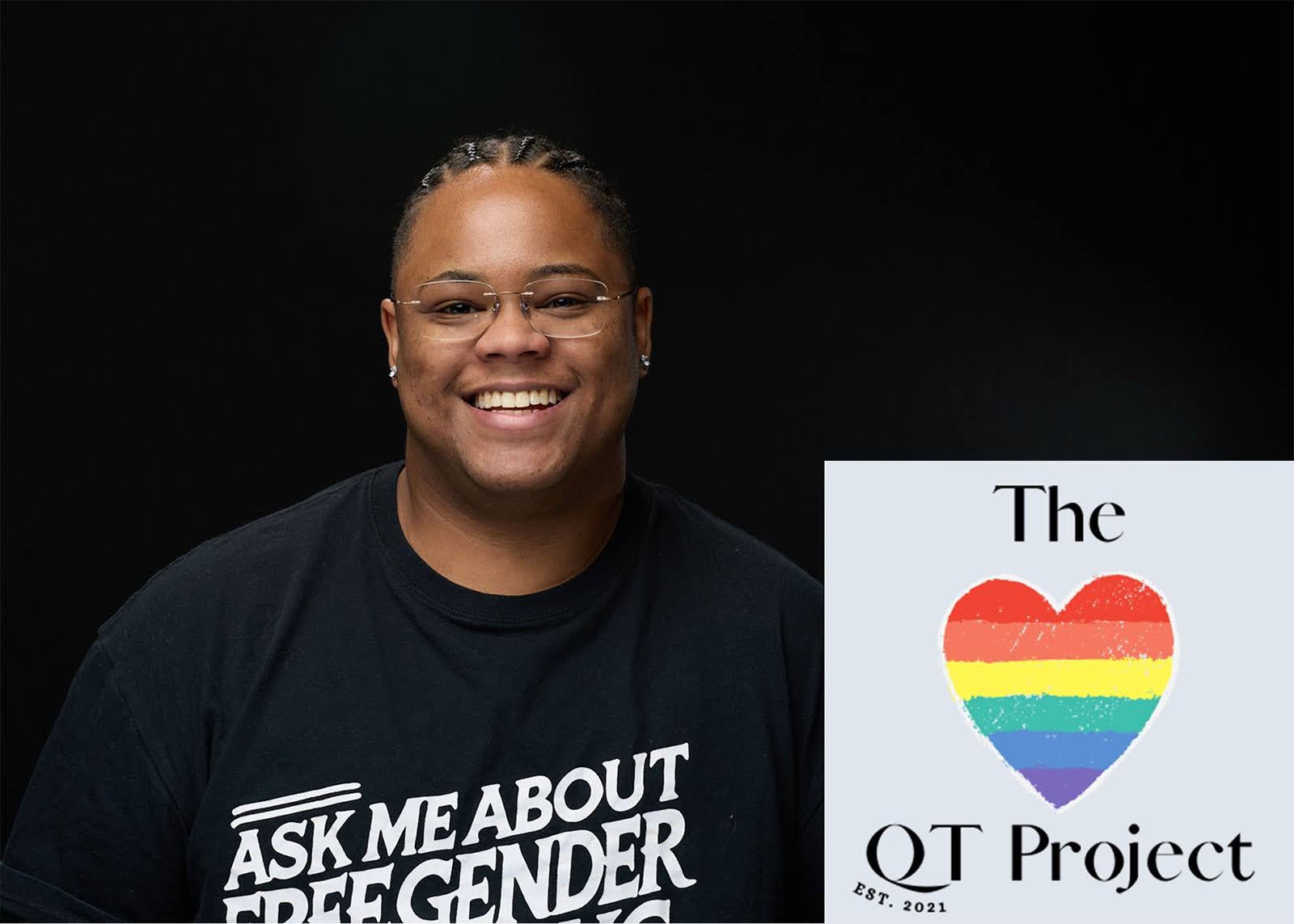
Cielo Sunsarae headshot by NeverStill Studio. The QT Project logo licensed CC BY-SA 4.0.
Facing hostile federal and state regulation, trans, nonbinary, and gender-nonconforming folks have struggled to access gender-affirming care. The Queer Trans Project, a Black- and trans-led nonprofit based in Jacksonville, Fla., has been stepping up to fill the need. Founded in 2021 by Black transmasculine organizer Cielo Sunsarae (they/he), who also serves as the executive director, the tiny staff of the QTP has worked hard to distribute free supplies and other trans-supportive assistance nationwide.
The QTP’s flagship offering is its customizable “Build-A-Queer” kit, which contains products for binding, tucking, and other gender-affirming needs. These kits, funded by donations and merchandise sales, are completely free of charge, discreet shipping included, to anyone in the U.S. who needs gender-affirming care.
The Build-A-Queer kits are offered a few times a year on a first-come, first-served basis, and all items are claimed very quickly. Those interested can sign up to be notified before each distribution date, and early access for BIPOC and disabled community members is available on an application basis. During each distribution, participants create an account and choose items to add to their kits on the QTP website. The next distribution of these free kits will be on Nov. 17, 2026, and include over 5,000 items.
The QTP also partners with Elevated Access, a nonprofit with a network of volunteer pilots providing flights on private planes, to arrange free flight assistance for trans folks needing emergency relocation or access to medical care.
Assigned Media reached out to Sunsarae to talk about the QTP and the state of trans life in the U.S. (The interview has been lightly edited for length and clarity.)
Assigned Media: What are your thoughts on the risks and rewards of being visible as a trans person in the U.S. today, particularly for a Black trans person?
Cielo Sunsarae: I want to preface with this: One’s (in)visibility is a personal decision based on what’s best for their needs. Visibility is a double-edged sword—at least, that’s what our opponents have made us believe. With visibility comes those who are with us, and those who are against us, to the extent of using us as a political pawn.
For me, the rewards vastly outweigh the risks to be visible as a trans person, but especially as a Black trans person. When I first started questioning my gender identity (and honestly, my sexuality too), I couldn’t find anyone who looked like me (Black, fat trans), so I initially rejected the possibility that I could be trans. In that, I made my own platform on social media and found my community, founded QTP, and myself. Being visible means there’s one other person out there who doesn’t feel so alone, isolated, and believing they can’t be who they are.
AM: The QTP’s flight assistance grants can help with emergency relocation to other states. Have you yourself considered leaving Florida due to the anti-trans legislation?
CS: I can honestly say that has crossed my mind to keep me and my family safe. During the height of the anti-trans legislation in Florida (2023), there was a lot of clickbait and sensationalist news everywhere to pander to panic; as someone caught up in the work, it was easy to fall into that panic at times. At the same time, however, being immersed in the work—at the Capitol daily throughout legislative sessions, and actively having to track, analyze and disseminate info throughout the state—I was keyed in on everything before most of the public was, so I was able to take a step back and make rational decisions.
The most important thing I learned and saw for myself (which we see now) is how Florida was/is the testing ground for the rest of the country, so moving wouldn’t have done much for too long. Moreover, they want us all to move out of Florida, but it’s that resistance that has always furthered grassroots movements. Florida is the second-most populous state of transgender people, and despite what they try to do, there will always be those of us here who will fight back for what’s right, and make this a safe space again for those who may want to move back.
AM: In a 2023 interview, you mentioned giving BIPOC folks early access to order your Build-A-Queer kits. Can you share your reasons for this policy, and any pushback you’ve received over it?
CS: BIPOC people face multiple layers of barriers at any given moment. Our Early Access program helps to offset those extra systemic barriers. For example, a Black trans person in Gary, Ind., doesn’t have the same internet speed or access as a white trans person in San Jose, Calif., so being an Early Access recipient helps them secure the gender-affirming items they need without having to race against those with faster/more reliable internet.
Notably, we’ve expanded our Early Access program to include disabled trans individuals, thanks to support from Borealis’s Disability Inclusion Fund, and listening to the needs of our community. For example, a trans person dealing with severe chronic fatigue or brain fog can be completely exhausted by the high-stress race to order our limited supplies. Early access provides them a calmer, extended window to secure their gender-affirming items without draining their limited daily energy (“spoons”). It’s now our Early Access Program for BIPOC and Disabled Trans Folks, because our disabled/chronically ill community faces barriers to access similar to our BIPOC community.
AM: What are the most popular items in your Build-A-Queer kits?
CS: This is a slightly difficult question because it depends on how you look at it. Demand-wise, all of our items are popular and very needed; when we restock, all of our items are claimed in less than 30 minutes. Item-wise, our most popular items are definitely our chest binders, Gender Grip tape, packing boxers, Silicon Packer, and Health Bundle. However, that’s because we serve more transmasculine people than transfemme, so naturally we have more of those items.
Going back to the topic of visibility, it can be hard for transfemme people to trust or even access necessary resources, so many don’t know what’s out there to help them. We’ve been working hard on changing that. When we began, we didn’t serve any transfemme people. Now, a good portion of our recipients are transfemmes who highly request our prosthesis bras, tucking gaffs and silicone breast forms.
AM: What other assistance would you like to offer to trans and nonbinary folks if you had the resources?
CS: The dream goal is to make our gender-affirming items available year-round and worldwide. I know we’ll get there. We have a massive international audience in the U.K. and Canada (pretty tied), followed by Australia and Germany. When we began, our restocks only occurred biannually, and now they’re quarterly! Someday, QTP will have a distribution system as robust as Amazon—minus the unethics—providing gender-affirming care to trans people in need worldwide.
With our flight program, we work in partnership with Elevated Access to connect trans people to no-cost flight support for relocation or accessing gender-affirming care. Gender-affirming care is expensive, so even covering just a flight makes a world of a difference. A majority of those we serve say they wouldn’t be able to access care without having received travel assistance. My dream for this is to take the support even further, perhaps working with hotels or Airbnb to cover accommodations for those in need, for a more full-service support cycle.
AM: Can you share any future career goals for yourself?
CS: I’m a lifelong learner. A huge chunk of that means being able to intentionally listen and understand. No matter where QTP is tomorrow, five or even 30 years from now, I want us to be known by our members as an org that evolves alongside their needs.
That’s why the insights and feedback we get from our members are foundational to our programming. We pay close attention to the data to help inform our work, but also so we can present the needs and the positive impact of social gender affirmation at conferences, workshops, in research, etc. and help shift the anti-trans narrative about our community.
AM: Anything else you’d like to add?
CS: There’s significant focus and conversation regarding medical transition/affirmation, which is a topic that opponents love to latch onto to stoke their anti-trans narrative. So, on our side, conversations and research about social gender affirmation are few and far between, even though it’s often the first step in a trans person’s journey of affirmation. Early data of ours shows a profound positive impact on a trans person’s mental health and emotional wellbeing when they are socially affirmed (name, pronouns, wearing gender-affirming items like what we offer). And contrary to the belief that trans people don’t know who they are, more than half of respondents reported feeling comfort in their identity. Yet 77 percent said that accessing the care they need is difficult.
Having confidence in your identity does not equate to access to resources. Trans people know who they are, but can lack the financial means, safety, or availability to express themselves. That’s our “why”: to help our trans community feel at home in their bodies and in the world, by removing barriers to care, transforming narratives, and activating communities.
Pax Ahimsa Gethen (they/them) is a queer Black trans writer and editor. They live in San Francisco with their spouse Ziggy.